
When people think about Madera County, they may picture the Central Valley, the Sierra Nevada, Highway 99, the road toward Yosemite National Park, or the agricultural fields that stretch across the landscape. Yet behind those familiar sights is a much longer story—one shaped by farming, ranching, irrigation, transportation, immigrant labor, family businesses, and generations of agricultural families.
Agriculture did not simply become one part of Madera County’s economy. It helped shape the communities, roads, businesses, neighborhoods, and traditions that developed throughout the region.
Today, Madera County remains an important agricultural area in California. Almonds, pistachios, grapes, milk, cattle, alfalfa, nursery products, and other commodities contribute substantially to the county’s economy. UC Cooperative Extension identifies almonds, pistachios, milk, and grapes among the county’s leading agricultural commodities.
Understanding that modern agricultural landscape requires looking backward. The story begins long before today’s orchards and vineyards.
The Land Before Modern Farming
The agricultural history of Madera County is part of a much older human history.
Before European settlement and modern commercial agriculture, Indigenous peoples lived throughout the region and developed relationships with the Central Valley, foothills, rivers, forests, and surrounding mountains.
According to Madera County historical planning documents, Indigenous communities in the region included Northern Valley Yokuts, Foothill Yokuts, Sierra Miwok, and Monache peoples. Their knowledge of the local environment predates the farms, roads, towns, and commercial industries that later transformed the landscape.
This earlier history is important because agriculture did not begin when commercial farms appeared. People had already been living with and managing the land for generations.
The arrival of European settlers and the growth of California’s population brought major changes. During the 19th century, economic development accelerated throughout the Central Valley. Mining, ranching, timber, transportation, and farming all contributed to the transformation of the region.
Madera County eventually became a distinct county in 1893 after separating from Fresno County.
By that point, the foundation for a community increasingly connected to agriculture was already developing.
From Lumber to Agriculture
Interestingly, the name “Madera” itself reflects an earlier economic chapter.
“Madera” is Spanish for “wood” or “lumber.” County historical documents identify lumber as the area’s first major industry.
Timber and agriculture may seem like separate stories, but they were connected to the broader development of Madera County.
Timber helped create economic activity and transportation networks, while agricultural settlement expanded across the flatter portions of the county. As communities developed, farmers needed roads, markets, warehouses, equipment suppliers, banks, laborers, and transportation services.
The growth of one industry could therefore support another.
Over time, agriculture became increasingly important to the county’s identity. The landscape began changing from large areas of undeveloped land and ranching territory into a patchwork of cultivated fields, orchards, vineyards, dairies, and other agricultural operations.
The Importance of Water and Irrigation
No discussion of California agriculture is complete without discussing water.
The Central Valley’s Mediterranean climate provides long, dry summers that can be highly productive for agriculture, but successful farming depends heavily on reliable irrigation.
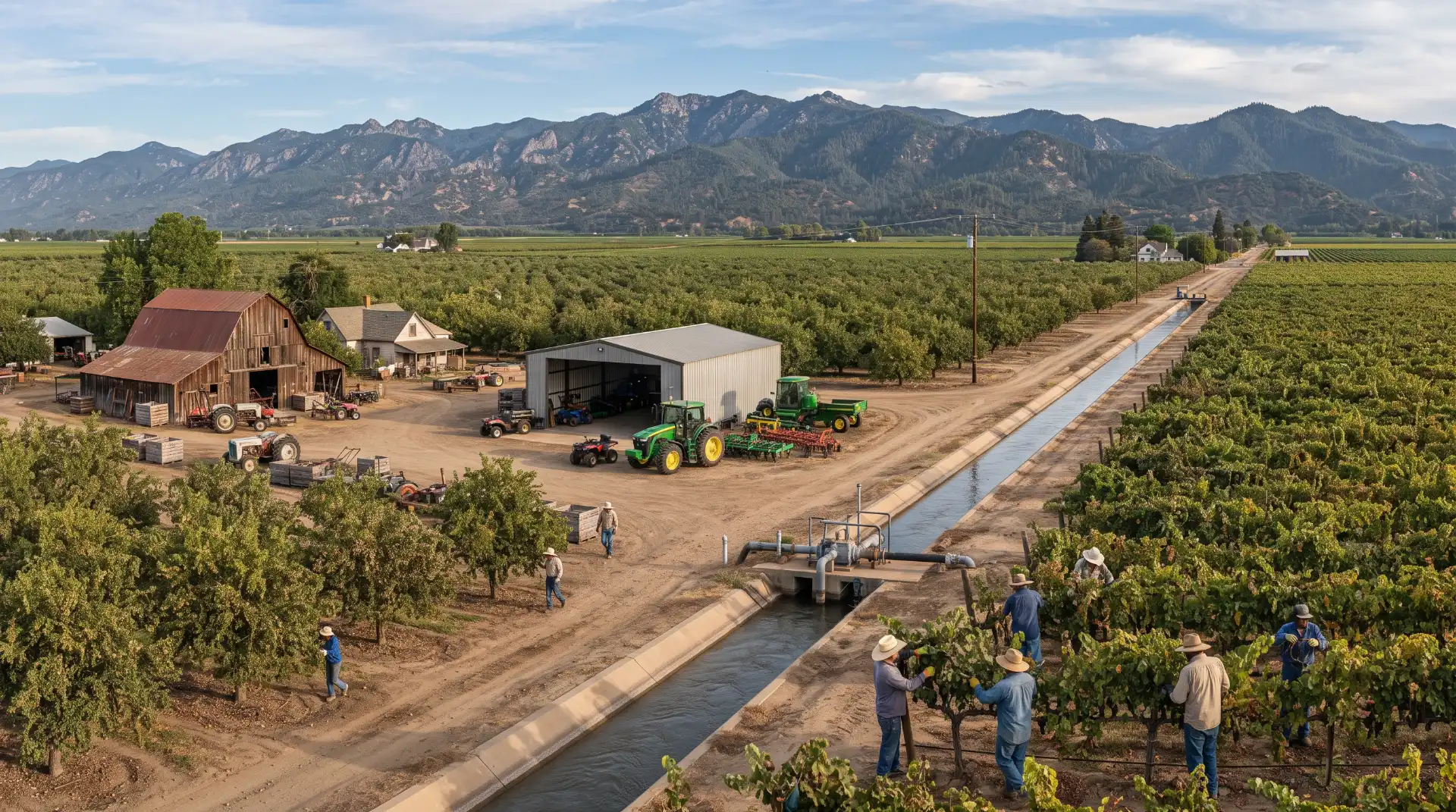
For Madera County farmers, water infrastructure has been an essential part of agricultural development. Irrigation makes it possible to grow crops that require dependable water during the summer growing season.
The importance of irrigation can be seen in the agricultural landscape itself. Orchards and vineyards require carefully managed water supplies, while dairy operations and field crops also depend on agricultural water systems.
Water has therefore been more than an environmental issue. It has been an economic and historical force.
The availability, cost, management, and reliability of water have influenced what farmers could plant and how agricultural businesses could operate.
This is one reason the history of Madera County agriculture is also a history of infrastructure.
Railroads and the Growth of Madera
Transportation was another major factor in the development of commercial agriculture.
Farmers could grow crops, but successful commercial agriculture also required a way to move those crops to buyers and markets.
Rail transportation became especially important to agricultural communities throughout California’s Central Valley. Railroads connected rural areas with larger cities and commercial centers, making it easier to transport agricultural products over longer distances.
As transportation improved, farming became increasingly connected to regional, national, and eventually international markets.
Madera’s development was closely tied to these transportation changes. Agricultural communities needed loading facilities, warehouses, packing operations, equipment suppliers, and other businesses.
The result was a cycle of economic growth.
Farm production supported businesses, while businesses and transportation networks made it easier for farmers to sell their products.
That relationship helped turn agriculture into a community-building force.
The Rise of Orchards and Vineyards
Madera County’s agricultural identity has changed considerably over time.
Older generations would have recognized crops and agricultural practices that are different from some of the dominant commodities seen across the county today.
Historical agricultural statistics demonstrate this change.
For example, Madera County’s 1977 agricultural data listed grapes, cotton, and alfalfa among its leading commodities. By 1987, grapes and almonds were major commodities, while pistachio production had expanded significantly. By 1997, grapes, almonds, and milk were among the leading commodities, while pistachio acreage had continued to grow.
These changes illustrate an important part of agricultural history: farms evolve.
Farmers respond to market demand, commodity prices, production costs, water availability, technology, consumer preferences, and environmental conditions.
A field that produced one crop several decades ago might be planted with a completely different crop today.
Grapes and Madera County’s Agricultural Identity
Grapes have played an especially important role in Madera County agriculture.
The county has long been associated with grape production, including raisin, table, and wine grapes.
Historical crop reports show grapes among Madera County’s leading agricultural commodities across multiple decades. In 1977, grapes were the county’s highest-value commodity in the cited crop report. Grapes were also among the leading commodities in later decades.
Grape production connects Madera County to a much larger California agricultural story.
California became one of the nation’s most important wine and grape-producing regions, and Central Valley vineyards also became significant producers of grapes for raisins and other markets.
The vineyards visible around Madera County are therefore not simply fields of crops. They represent generations of agricultural knowledge and changing consumer markets.
Almonds and the Transformation of the Landscape
Almonds provide another example of how Madera County agriculture has changed.
Modern Madera County is strongly associated with almond production. UC Cooperative Extension currently lists almonds, nuts, and hulls as the county’s highest-value agricultural category among its top commodities.
But almonds were not always as dominant as they are today.
Historical agricultural data show the expansion of almond acreage and value over the decades. In 1977, almonds ranked sixth among the county’s leading crops. By 1987, almonds ranked second, and by 1997 they were again one of the county’s two leading commodities.
This transformation is visible across the Central Valley.
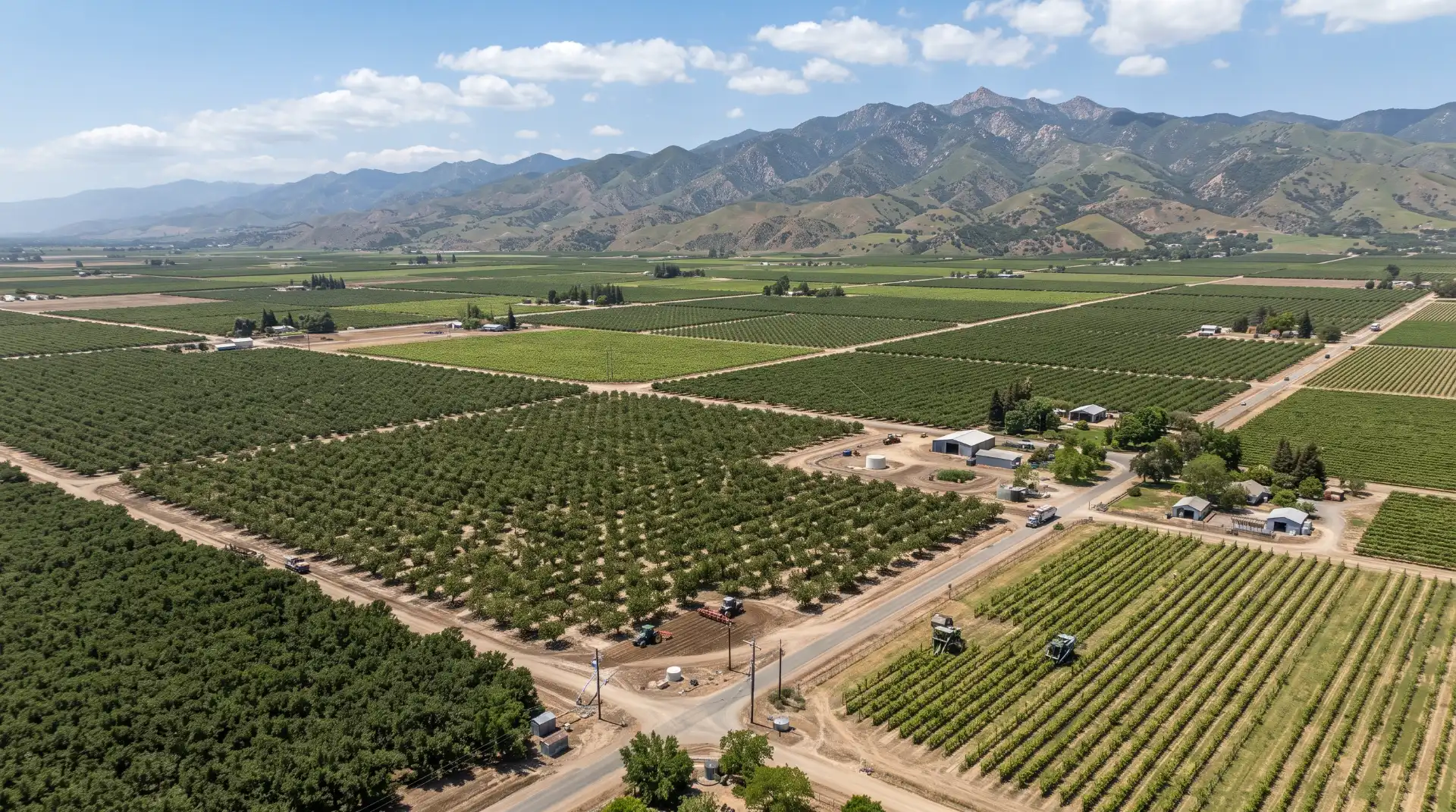
Rows of almond trees have become a defining feature of the agricultural landscape. During bloom season, orchards can create a dramatic display of white and pale-pink blossoms.
For local residents, these orchards are more than an agricultural product. They have become part of the visual identity of Madera County.
Pistachios Become an Agricultural Powerhouse
Pistachios offer another fascinating example of agricultural change.
In the late 1970s, pistachios were still a relatively small commodity in Madera County. The historical crop report noted only a few hundred harvested acres in 1977. Ten years later, bearing pistachio acreage had expanded dramatically.
By later decades, pistachios had become one of the county’s major agricultural commodities.
This history demonstrates how agricultural landscapes can change within a single generation.
A crop that once occupied a relatively small amount of land can eventually become a major contributor to the local economy.
Today, pistachios are one of Madera County’s leading agricultural commodities, according to UC Cooperative Extension.
Dairy Farming and Ranching
Madera County agriculture is not limited to orchards and vineyards.
Dairy farming, cattle, replacement heifers, poultry, hay, and other livestock-related activities are also part of the county’s agricultural economy.
Milk has repeatedly appeared among Madera County’s leading agricultural commodities.
Historical reports show milk becoming increasingly valuable over the second half of the 20th century. In 1977, milk ranked fourth by value; by 1997, it remained among the county’s leading commodities.
Modern agricultural data continue to show dairy as a major part of the county’s economy. UC Cooperative Extension currently lists milk among Madera County’s top agricultural commodities.
Dairy farms also demonstrate how agriculture supports more than the farm itself.
A dairy operation requires feed, veterinary services, equipment, transportation, maintenance, labor, and other services. Those connections create economic activity throughout the surrounding community.
Farming and the Growth of Local Communities
Agriculture helped shape where people lived and worked.
Farm workers, farmers, business owners, mechanics, truck drivers, equipment dealers, agricultural specialists, food processors, and other workers all became part of the agricultural economy.
Small communities throughout California’s Central Valley often developed around agricultural production.
Madera was no exception.
As farms expanded, communities needed schools, stores, churches, banks, roads, restaurants, repair shops, and other services.
Agriculture therefore influenced the physical development of the county.
The relationship between farming and community development is one of the most important themes in Madera County history.
The Human Side of Agricultural History
Statistics tell only part of the story.
Behind every acre of almonds, vineyard row, dairy, or field crop are people.
Agricultural history includes farm families who owned or leased land, workers who planted and harvested crops, truck drivers who moved products, mechanics who repaired equipment, agricultural inspectors, irrigation specialists, teachers, merchants, and many others.
Madera County’s agricultural history is therefore also a history of work.
The seasonal nature of many agricultural operations created distinctive patterns of employment and community life. Harvest periods could bring increased demand for labor, while other parts of the year involved pruning, planting, irrigation, maintenance, and preparation for the next season.
These rhythms influenced family life and local businesses.
They also contributed to the cultural diversity of California’s Central Valley.
Agricultural Technology Changes the County
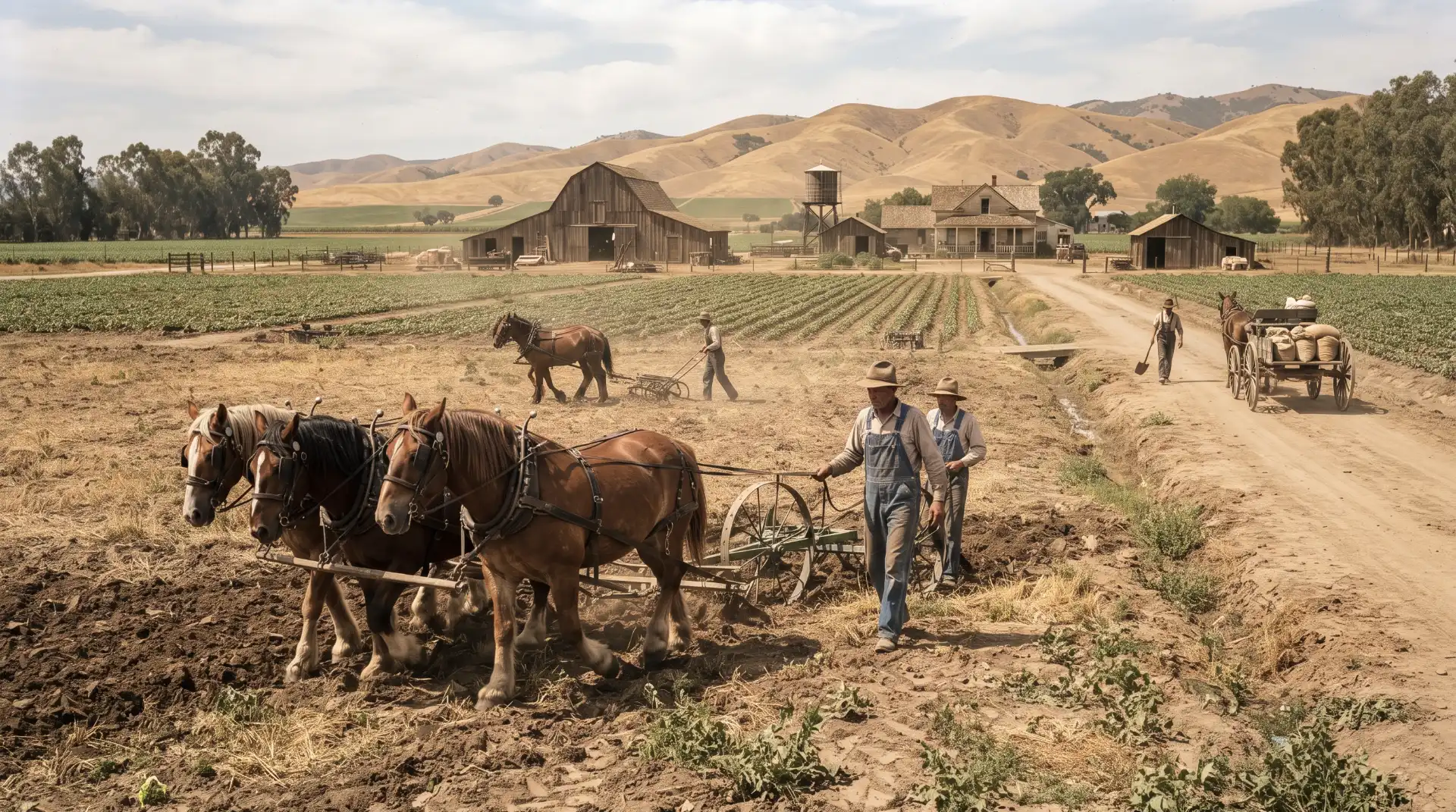
Farming in Madera County today looks very different from farming a century ago.
Tractors and specialized harvesting equipment have replaced much of the manual labor once required for many agricultural tasks.
Irrigation systems have become more sophisticated. Agricultural research has improved pest management, crop selection, soil management, and water-use practices.
UC Cooperative Extension continues to conduct agricultural research and educational programs relevant to Madera County, including work involving field crops such as cotton, alfalfa, and small grains.
Technology has also changed how farmers make decisions.
Modern growers can use weather information, soil measurements, irrigation monitoring, GPS-based equipment, crop research, and other tools to manage agricultural operations.
Yet the basic goal remains familiar: produce crops and livestock efficiently while responding to the conditions of the land and marketplace.
Why Madera County Agriculture Keeps Changing
One of the most interesting lessons from Madera County’s agricultural history is that farming has never remained static.
UC Cooperative Extension notes that acreage devoted to field crops has declined over the past several decades as some land has shifted toward higher-value tree fruit, nut crops, and vineyards.
This is an important historical trend.
When commodity prices change or production costs rise, farmers may reconsider what they plant.
A perennial orchard is a long-term investment, while annual crops offer different economic and management considerations.
Changes in technology, consumer demand, water conditions, labor availability, and agricultural markets can all influence those decisions.
As a result, the agricultural map of Madera County continues to evolve.
Agriculture and the Local Economy
The importance of agriculture can also be measured economically.
A Madera County planning document identified agriculture as the county’s largest industry and reported that it accounted for approximately 30 percent of county employment at the time of that analysis.
Although economic conditions change over time, the broader point remains significant: agriculture has historically extended far beyond the farm gate.
A successful agricultural industry supports numerous related businesses.
Farm equipment dealers sell tractors and specialized machinery. Mechanics maintain agricultural equipment. Trucking companies move products. Banks and financial institutions provide agricultural financing. Agricultural suppliers provide fertilizers, irrigation equipment, and other inputs.
Restaurants, grocery stores, housing, schools, and local services are also connected indirectly to the agricultural workforce.
This is why farming helped build the community.
Historical Crop Reports as a Window Into the Past
One of the best ways to explore Madera County’s agricultural history is through historical crop reports.
Madera County maintains archives of annual crop and livestock reports, including reports from the 1940s and other decades.
These records are valuable because they allow researchers and residents to see how agriculture changed over time.
A crop report can show which commodities were important during a particular period, how production values changed, and how the agricultural economy responded to broader economic conditions.
For anyone interested in local history, these reports provide a fascinating connection between statistics and everyday life.
They can answer questions such as: What did farmers grow decades ago? Which crops disappeared? Which commodities expanded? How did the value of agriculture change?
Historical documents make it possible to investigate those questions rather than relying only on memories or general assumptions.
Preserving Madera County’s Agricultural Heritage
Agricultural history is worth preserving because the landscape is constantly changing.
An orchard may be removed. A farm building may disappear. A family farm may change ownership. A historic piece of equipment may no longer be used.
Photographs, oral histories, newspaper articles, crop reports, maps, property records, and family documents can help preserve the stories behind those changes.
Local history websites can play an important role in bringing those materials together.
Madera County’s agricultural heritage belongs not only to farmers but to the entire community because farming helped influence the county’s economic, cultural, and physical development.
A historic barn, an old irrigation structure, a photograph of a harvest crew, or a vintage tractor can tell a larger story about how people lived and worked.
The Agricultural Landscape Today
Madera County’s agricultural economy remains diverse.
UC Cooperative Extension’s current agricultural information lists almonds, pistachios, milk, grapes, cattle and calves, replacement heifers, alfalfa, hay and silage, nursery stock, and poultry among its leading commodities.
This diversity reflects decades of agricultural adaptation.
Madera County farmers produce tree nuts, grapes, dairy products, livestock, field crops, and other commodities. The result is a landscape that combines traditional agricultural practices with modern technology.
The county’s agricultural identity is therefore not simply a relic of the past.
It is a living part of the community.
What Farming Means to Madera County’s History
Looking across more than a century of development, it becomes clear that farming influenced Madera County in ways that go well beyond crop production.
Agriculture helped create jobs.
It supported businesses.
It encouraged transportation development.
It contributed to the growth of communities.
It shaped the landscape.
It brought generations of families to the area.
It connected Madera County to markets throughout California, the United States, and the world.
And it left behind an extensive historical record.
The crops have changed, farming methods have evolved, and technology has transformed the work, but agriculture continues to be part of Madera County’s identity.
Preserving the Stories Behind the Fields
When driving through Madera County today, it can be easy to see an orchard or vineyard simply as part of the scenery.
But every agricultural landscape has a story.
A row of almond trees represents decades of agricultural investment and changing markets. A vineyard reflects generations of grape production. A dairy represents an industry that has remained part of the county’s agricultural economy for decades. An old farm building can preserve evidence of how earlier generations worked the land.
These details are important pieces of local history.
The future of Madera County will continue to bring changes to agriculture. New technologies, new crops, new economic pressures, and new environmental challenges will influence what the county’s agricultural landscape looks like in the decades ahead.
That makes it even more important to preserve the history that came before.
Final Thoughts
Madera County’s agricultural history is ultimately a story about people and place.
The county developed through many industries, including lumber, ranching, transportation, and agriculture. But farming became one of the forces that helped shape the communities and economy that residents recognize today.
From early fields to modern almond orchards and vineyards, from historic crop reports to today’s agricultural research, the story of farming in Madera County demonstrates how closely local history is connected to the land.
Understanding that history gives residents and visitors a different way to see the Central Valley.
The next time you travel through Madera County and pass a vineyard, almond orchard, dairy, ranch, or agricultural field, remember that the landscape represents much more than today’s harvest.
It represents generations of work, adaptation, community building, and change.
That is why Madera County’s agricultural history deserves to be remembered and preserved.