
Deep in the Sierra National Forest of eastern Madera County stands a place where California’s natural and human histories are written into living trees. Nelder Grove is home to towering giant sequoias, enormous historic stumps, old logging routes, archaeological resources, and reminders of the people who lived and worked beneath the forest canopy long before the area became a destination for hikers and history enthusiasts.
The Nelder Grove giant sequoias are part of one of the most extraordinary tree species on Earth. Giant sequoias grow naturally only along a limited band of the western Sierra Nevada in California. Some individuals survive for thousands of years, developing trunks of remarkable volume and thick, fire-resistant bark.
Yet the history of Nelder Grove is not simply the story of ancient trees surviving untouched wilderness. The grove has experienced Native American use, nineteenth-century settlement, intensive logging, early conservation efforts, wildfire, scientific study, and changing ideas about how giant sequoia forests should be protected.
Today, Nelder Grove represents one of Madera County’s most important natural heritage landscapes. Its surviving giants help visitors understand both the resilience of the Sierra Nevada and the consequences of decisions made more than a century ago.
Where Is Nelder Grove?
Nelder Grove lies in Sierra National Forest in eastern Madera County, south of Yosemite National Park and near the communities of Oakhurst and Fish Camp. The grove occupies a forested section of the western Sierra Nevada where giant sequoias grow among sugar pine, ponderosa pine, white fir, incense cedar, and other mountain vegetation.
U.S. Forest Service documentation describes Nelder Grove as a roughly 1,540-acre tract. Unlike the highly developed giant sequoia attractions found in some national parks, Nelder Grove historically retained a quieter and more rustic character, with forest roads, trails, old cabins, logging remnants, and large trees appearing unexpectedly through dense forest.
The grove’s location is important. Giant sequoias do not naturally grow throughout California despite becoming one of the state’s most recognizable symbols. Their native distribution is concentrated in scattered groves along the western slope of the Sierra Nevada.
Nelder Grove therefore represents a small piece of a globally unusual ecosystem.
A Landscape Known Long Before Written Records
The history of Nelder Grove begins long before it received its modern name.
U.S. Forest Service historical material notes that archaeological evidence indicates Southern Sierra Miwok people knew and used the grove for thousands of years. The forest provided places for seasonal camping, hunting, travel, and gathering resources such as acorns.
This earlier history is important because nineteenth-century accounts sometimes describe giant sequoia groves as though Euro-American explorers suddenly discovered previously unknown landscapes. Native communities already possessed detailed knowledge of the Sierra Nevada and had interacted with its forests for generations.
The giant trees existed within cultural landscapes rather than isolated wilderness. Forests provided food, plant materials, wildlife, water, travel corridors, and gathering places that connected Native communities across the foothills and mountains.
Understanding this deeper timeline also changes how visitors interpret the grove. The oldest surviving sequoias were already ancient when Spanish missions were established along the California coast and centuries old when Europeans first reached North America.
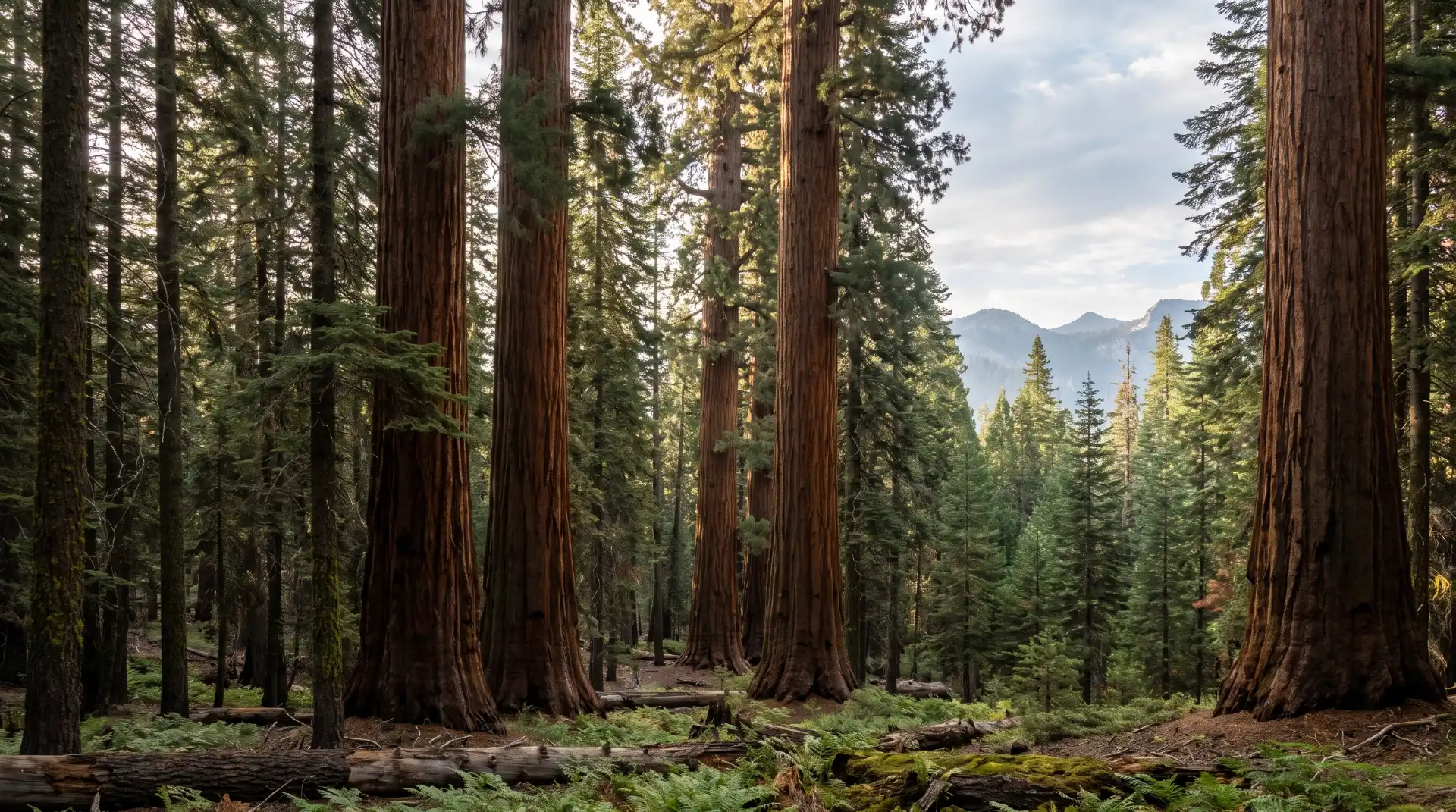
The Giant Sequoia: A California Original
The giant sequoia, scientifically known as Sequoiadendron giganteum, is famous for its enormous volume. Although California’s coast redwoods can grow taller, giant sequoias develop extraordinarily massive trunks and rank among the largest living organisms on Earth.
Their size is only one remarkable characteristic.
Mature giant sequoias can possess bark more than a foot thick. This fibrous bark offers significant protection from ordinary surface fires. Large trees can survive repeated burns during lives spanning thousands of years, and blackened fire scars visible on old trunks often record centuries of changing forest conditions.
Fire is not merely something giant sequoias tolerate. It is also an essential part of their ecology.
According to research summarized by the U.S. National Park Service, periodic fire reduces competing vegetation, exposes mineral soil, opens portions of the forest canopy to sunlight, and contributes to the release of sequoia seeds. These conditions make it possible for a new generation of trees to become established.
Long-term tree-ring studies show that fire historically occurred much more frequently in giant sequoia forests than it did during much of the twentieth century. Modern research into this relationship has dramatically influenced forest-management practices throughout the Sierra Nevada.
John Nelder and the Grove’s Modern Name
The grove eventually became associated with John A. Nelder, a nineteenth-century settler whose name remains attached to the forest today.
Nelder came to California during the Gold Rush era and later established himself in the giant sequoia country. Historical accounts describe him living among the massive trees during the 1870s.
His life in the grove also became connected with one of America’s best-known naturalists, John Muir. Muir explored the Sierra Nevada extensively and became fascinated by giant sequoias, which later appeared prominently in his writing about California’s forests.
Historical accounts of Nelder Grove describe Muir meeting Nelder during his travels in the Sierra. Muir later wrote about the man and the remarkable forest surrounding his home.
The encounter represents an interesting intersection in California history. One man lived quietly among the trees while the other would become one of the country’s most influential advocates for wilderness preservation.
Yet even as admiration for giant sequoias grew, commercial pressure on California’s forests was accelerating.
Logging Comes to Nelder Grove
The late nineteenth century transformed Nelder Grove.
California’s expanding population created enormous demand for lumber. Towns, farms, railroads, mines, businesses, and rapidly growing cities required construction materials. Sierra Nevada forests appeared to timber companies as vast commercial resources.
Logging began in and around giant sequoia groves throughout the Sierra.
A federal environmental review of the region confirms that during the 1880s a lumber mill along California Creek within Nelder Grove processed giant sequoias. Other nearby mills also obtained timber from the surrounding forests.
Logging giant sequoias was exceptionally difficult.
Workers relied on long saws, wedges, axes, animal teams, cables, chutes, and increasingly sophisticated mechanical equipment. A tree that had taken well over a thousand years to reach maturity might require days of labor before it finally fell.
The enormous size of the trees created another problem. Giant sequoia wood can be relatively brittle. When a massive tree struck the ground, portions could split or shatter, reducing the amount of usable lumber.
Nevertheless, many trees were felled.
The giant stumps still visible throughout portions of Nelder Grove serve as physical evidence of this period. Their size can be startling. In some places, visitors can stand beside a stump wider than an ordinary room and imagine the living tree that once rose from it.
These remnants have become historical artifacts in their own right.
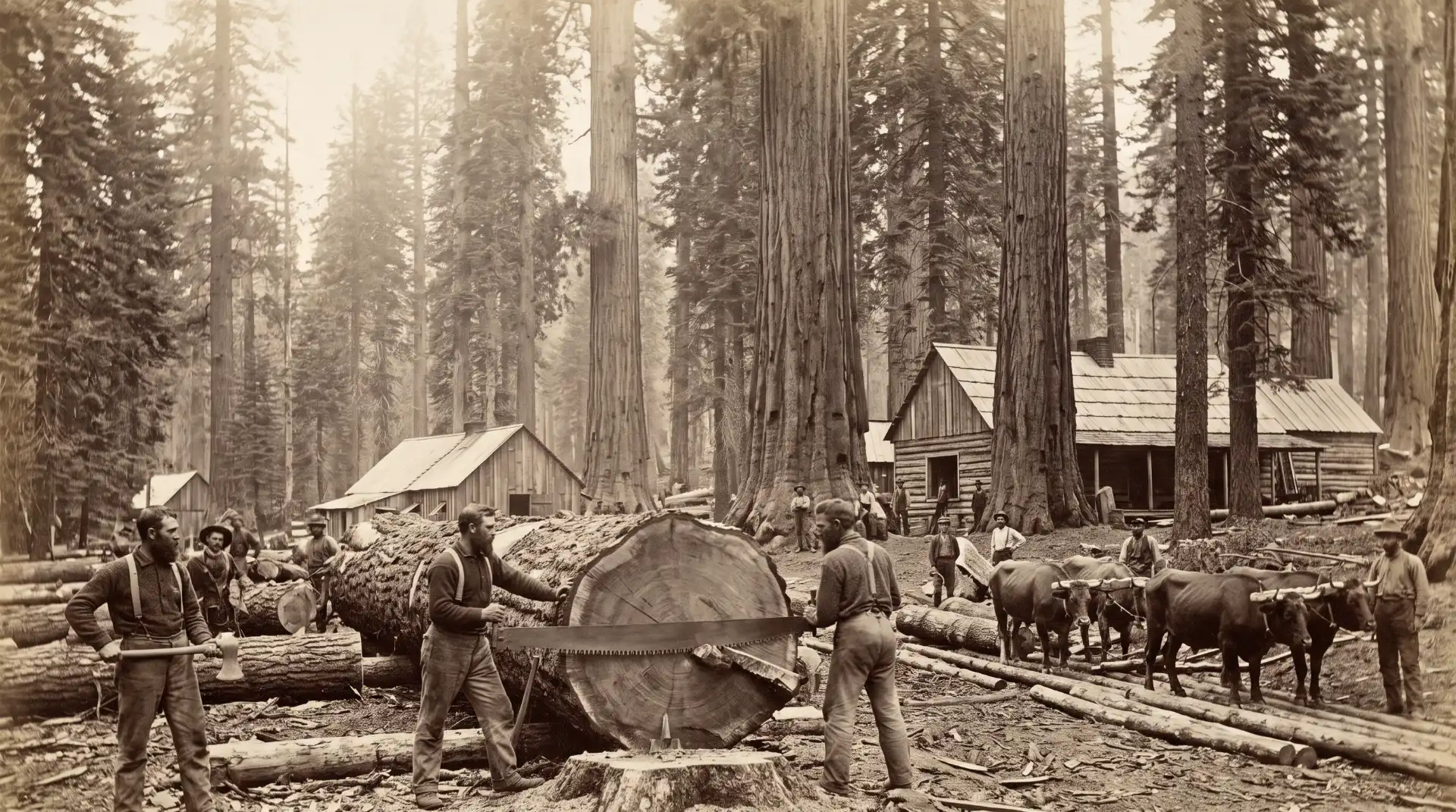
Logging Changed More Than Individual Trees
Removing a giant sequoia was more than the loss of a single tree.
Logging operations changed the entire forest environment. Roads and skid routes disturbed soils. Mills and worker settlements altered parts of the landscape. Other valuable conifers were harvested alongside sequoias. Timber transportation systems connected remote Sierra forests with growing communities in the San Joaquin Valley.
The broader Madera County lumber industry eventually became famous for elaborate railroads and flumes that moved enormous quantities of timber from mountain forests toward mills and markets.
This industrial network played a major role in Madera County’s economic history. Lumber supported jobs and development, but it also fundamentally altered many forests.
Nelder Grove provides unusually visible evidence of both sides of this history. Visitors can encounter living ancient trees and, only a short distance away, immense stumps left by nineteenth-century logging.
The contrast makes the grove an outdoor historical record of changing American attitudes toward natural resources.
The Bull Buck Tree
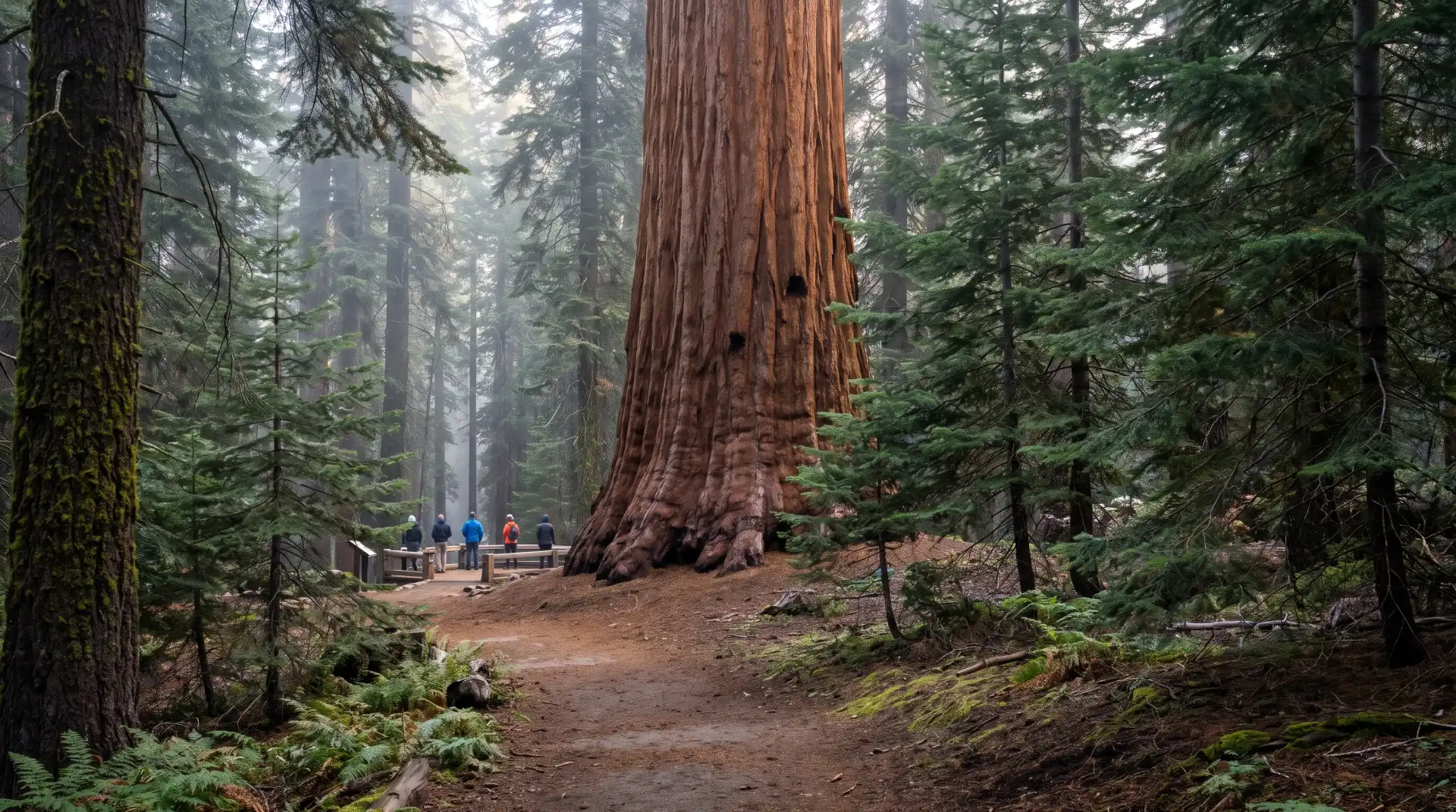
Among the surviving giants, the Bull Buck Tree has become Nelder Grove’s most famous individual sequoia.
Historic Forest Service materials describe Bull Buck as approximately 246 feet tall with a ground-level circumference of about 99 feet. It was once promoted as a contender for recognition among the world’s largest trees.
Rankings of giant sequoias can vary according to measurement methods, trunk volume, height, circumference, and changes that occur over time, so Bull Buck is best appreciated without relying heavily on competitive rankings.
Its physical scale is impressive enough.
The tree’s base appears almost architectural, resembling a tower rising from the forest floor. Looking upward, visitors can see the trunk narrow gradually before disappearing into a crown far above the surrounding understory.
The Bull Buck also illustrates why old sequoias can survive for extraordinary periods. Its thick bark protects living tissue from many fires, while its enormous trunk allows the tree to withstand damage that could kill smaller species.
At the same time, no sequoia is indestructible. Drought, severe wildfire, structural damage, changing climate conditions, and other stresses can threaten even trees that have survived for centuries.
Shadow of the Giants
One of Nelder Grove’s best-known trails is the Shadow of the Giants National Recreation Trail.
Forest Service materials describe it as an approximately one-mile interpretive walk following part of Nelder Creek. Signs along the route traditionally explain the ecology of giant sequoias and their relationship with surrounding forest species.
The trail was originally constructed in 1965 and became a National Recreation Trail in 1978.
Its creation reflected an important change in how the grove was viewed. Where earlier generations had seen timber that could be harvested, later visitors increasingly saw the forest as a place for recreation, scientific study, education, and preservation.
The name “Shadow of the Giants” captures the experience particularly well. Mature sequoias can dominate the surrounding landscape even when they are partly hidden by firs, pines, dogwoods, and dense vegetation.
Walking through the grove often reveals the trees gradually rather than presenting them in a single open vista.
The Grove Becomes a Historical Landscape
Eventually, the significance of Nelder Grove extended beyond its surviving trees.
The U.S. Forest Service recognized that the area’s logging remnants, historical structures, archaeological resources, old trails, and giant sequoias formed a connected cultural landscape.
Historic management documents identify preservation of both the large trees and the remnants of Native American and logging history as objectives for Nelder Grove.
This approach gives visitors several layers of history to explore.
Restored cabins and interpretive areas tell the story of people who lived and worked in the mountains. Logging chutes and transportation replicas help explain how timber moved through difficult terrain. Giant stumps reveal the scale of nineteenth-century logging. Living sequoias show what survived.
Together, these features make Nelder Grove different from a purely scenic forest.
It is an outdoor historical site where natural history and industrial history overlap.
Why Fire Is Essential to Giant Sequoias
For much of the twentieth century, fire suppression was considered one of the central responsibilities of forest management throughout the American West.
The logic seemed straightforward: fire destroyed trees, buildings, wildlife habitat, and valuable timber, so extinguishing fires appeared to protect forests.
Scientists eventually discovered that the relationship was far more complicated.
Giant sequoias evolved in forests where fire occurred repeatedly. National Park Service research indicates that fires historically burned through giant sequoia ecosystems at intervals ranging from roughly six to 35 years in many locations.
Lower-intensity fires consumed accumulated branches, needles, and competing vegetation. They created openings where sunlight reached the ground and exposed bare mineral soil where sequoia seedlings could establish themselves.
When fire disappeared from many groves, young sequoias became much less successful.
Dense understory vegetation also accumulated, increasing the amount of fuel available during future wildfires.
As this understanding developed, prescribed fire and other forest-restoration techniques became increasingly important tools for giant sequoia conservation.
The Railroad Fire and a New Conservation Challenge
Nelder Grove’s modern history cannot be separated from the 2017 Railroad Fire.
The wildfire burned through a substantial portion of the grove and affected many giant sequoias. Federal researchers subsequently studied mortality and regeneration there, making Nelder Grove part of the broader scientific effort to understand how increasingly severe wildfires are affecting California’s giant sequoias.
The National Park Service has specifically referenced post-fire monitoring at Nelder Grove as researchers evaluated the effects of the Railroad Fire on previously inventoried trees.
The event also illustrates an important distinction between beneficial fire and catastrophic fire.
Giant sequoias depend on periodic burning, but that does not mean every wildfire is beneficial. Historically frequent surface fires often reduced fuel without killing large numbers of mature trees. Modern fires burning through dense fuels during extreme heat and drought can behave differently, sometimes reaching intensities that even ancient sequoias cannot survive.
This has become a major concern throughout California’s sequoia range.
National Park Service estimates indicate that exceptionally severe fires between 2020 and 2021 alone may have killed approximately 13 to 19 percent of the world’s large giant sequoias.
Although those figures describe the wider Sierra Nevada rather than Nelder Grove specifically, they show why active management of giant sequoia forests has become increasingly urgent.
New Sequoias After Fire
Wildfire can also create conditions for extraordinary regeneration.
Giant sequoia cones hold numerous tiny seeds. Heat, drying, insects, and other processes can cause the cones to release those seeds, but successful establishment requires favorable ground conditions and sufficient sunlight.
Fire can provide both.
Burned areas with exposed mineral soil and openings in the canopy may produce large numbers of seedlings following favorable conditions.
A scientific study published in 2024 specifically examined post-fire giant sequoia reproduction in Nelder Grove following the Railroad Fire. The research reflects growing interest in understanding whether natural regeneration can successfully restore portions of sequoia groves affected by modern high-severity wildfire.
This next generation of seedlings may someday form the ancient forest of the future.
The timeline involved is difficult for humans to comprehend. A sequoia seedling growing today could potentially remain part of the Sierra landscape long after today’s roads, buildings, and communities have changed beyond recognition.
Climate Change and the Future of the Giants
Giant sequoias have survived thousands of years of changing conditions, but modern forests face a particularly challenging combination of pressures.
Warmer temperatures, prolonged drought, accumulated forest fuels, insects, disease, and severe wildfire can interact in ways that place stress on mature trees.
Climate change does not mean that every giant sequoia will disappear. It does mean that land managers increasingly need to consider conditions that differ from those experienced during much of the species’ recorded ecological history.
Forest restoration can include prescribed burning, selective fuel reduction, scientific monitoring, removal of hazardous trees where necessary, and protection of young regeneration.
The objective is not to create a forest that never burns. Instead, modern management often seeks to restore ecological conditions in which fire can play its natural role without routinely developing into destructive, high-severity events.
A Connection to Madera County’s Logging History
Nelder Grove also provides an important link to the broader history of Madera County.
During the late nineteenth and early twentieth centuries, timber became one of the defining industries of the eastern part of the county. Logging camps, sawmills, railroads, flumes, mountain roads, and worker communities expanded across the Sierra.
Timber harvested in the mountains helped support development in the San Joaquin Valley.
Understanding Nelder Grove therefore requires avoiding a simple story in which loggers are portrayed only as destroyers and conservationists only as rescuers. Logging provided livelihoods to families and helped build growing California communities. At the same time, industrial-scale harvesting demonstrated that even forests containing seemingly limitless trees could be permanently altered.
The surviving stumps at Nelder Grove allow modern visitors to confront that complicated history directly.
They show both the technical ambition of nineteenth-century industry and the environmental cost of treating centuries-old trees as an inexhaustible resource.
What the Old Stumps Can Teach Us
One of the most powerful experiences at Nelder Grove may not involve a living tree at all.
Old sequoia stumps remain scattered through portions of the forest. Many have endured for more than a century because giant sequoia wood decays relatively slowly under appropriate conditions.
The stumps reveal the extraordinary diameter of trees that once stood there.
They also preserve evidence of historic cutting methods. Marks left by saws, axes, platforms, and logging equipment help explain the enormous effort required to bring down a mature sequoia before modern chainsaws and heavy machinery existed.
Instead of hiding this history, Nelder Grove allows the logged landscape to become part of the educational experience.
A surviving ancient tree beside an enormous old stump creates a comparison more powerful than a museum photograph. One represents continuity. The other represents irreversible loss.
Nelder Grove as Living History
The phrase “historic site” often brings to mind a courthouse, adobe building, battlefield, or preserved home.
Nelder Grove demonstrates that forests can also function as historic landscapes.
The trees themselves have witnessed dramatic changes. Some surviving sequoias were already mature before the Gold Rush. They stood while Native communities traveled through the mountains, while early settlers arrived, while logging companies established mills, while conservation movements gained influence, and while modern scientists began studying wildfire and climate change.
They are living historical objects on a scale few human-made structures can match.
At the same time, the forest continues to change. Trees fall. Seedlings emerge. Fire reshapes vegetation. Trails are repaired. Scientists collect data. Management practices evolve.
Nelder Grove is therefore not frozen in a particular year. Its history remains in progress.
Visiting Nelder Grove Responsibly
People interested in visiting Nelder Grove should remember that access conditions in Sierra National Forest can change because of wildfire recovery, hazard-tree removal, snow, road conditions, restoration projects, or temporary Forest Service orders.
Some roads in the area are unpaved and can be rough or unsuitable for certain vehicles.
Visitors should confirm current conditions with the U.S. Forest Service before traveling rather than relying solely on older travel guides or maps.
Within the grove, staying on established trails helps protect young vegetation and sensitive soils. Historic logging remnants, archaeological resources, tree bark, cones, and other natural or cultural features should remain where they are found.
Visitors should also avoid climbing on fragile structures or approaching areas closed for restoration.
These practices allow the grove to remain both an educational destination and a functioning ecosystem.
Why Nelder Grove Matters Today
Nelder Grove’s importance lies in the way several different stories converge in one place.
It preserves evidence of Native American use stretching far beyond written historical records. It contains some of California’s most extraordinary trees. It documents the rise of the Sierra Nevada timber industry and the environmental consequences of nineteenth-century logging.
It also illustrates the development of conservation itself.
Earlier Americans often viewed forests primarily in terms of the resources they could provide. Later generations increasingly recognized recreation, wildlife habitat, scientific research, cultural resources, scenic beauty, and ecological processes as values worth protecting.
Modern wildfire has added another chapter.
Managers now face the challenge of protecting ancient trees while restoring the natural role of fire in forests transformed by more than a century of human activity.
Madera County’s Giants Continue Their Story
For residents of Madera County, Nelder Grove is more than a scenic attraction near Yosemite. It is one of the county’s clearest connections to a history measured not merely in decades or centuries, but in millennia.
The giant sequoias standing there today have survived lightning, snowstorms, drought, repeated fires, logging activity, settlement, and generations of human change.
Some neighboring giants were not so fortunate. Their immense stumps remain as reminders of a period when California’s forests seemed too large to exhaust.
That combination of survival and loss gives Nelder Grove its distinctive character.
Visitors can walk beneath living trees, examine remnants of early industry, follow historic routes, and observe a forest continuing to regenerate around them.
The grove reminds us that preservation does not mean separating history from nature. At Nelder Grove, they are inseparable.
Every ancient trunk, fire scar, abandoned logging feature, young seedling, and weathered stump adds another layer to the story.
For more than a century, people have debated how giant sequoias should be used, protected, studied, and managed. Those questions remain relevant today as California confronts increasingly severe wildfire and changing climatic conditions.
Nelder Grove shows why the answers matter.
Its surviving giant sequoias are not simply impressive trees. They are witnesses to the changing history of Madera County and symbols of how a landscape can survive exploitation, recover from disturbance, and remain meaningful to new generations.
Protecting the grove means protecting that entire story — the ancient forest, the Native landscape, the logging history, the scientific record, and the young sequoias that may still be standing thousands of years from now.