In the oak-covered foothills northwest of Oakhurst, one of Madera County’s most important historic places tells a story that stretches far beyond the dates normally found on historical markers. Wassama Round House State Historic Park, near the community of Ahwahnee, is not simply a preserved building from California’s past. It remains a place connected to living Native American traditions, community gatherings, cultural continuity, and generations of people whose history in the Sierra Nevada predates the creation of Madera County itself.
The round house is particularly significant because its history did not end when California became a state, when the Gold Rush transformed the Sierra foothills, or when Native people were displaced from much of their ancestral land. Despite enormous upheaval, Native communities maintained connections to this place. Today, the site provides an unusually powerful example of how historic preservation can protect not only architecture but also cultural memory and continuing traditions.
For anyone interested in Madera County history, Wassama offers an important reminder that the region’s story begins long before logging camps, railroads, ranches, mines, or modern highways appeared. Understanding Wassama means looking at the much deeper Native American history of the Sierra foothills and recognizing that this history continues into the present.
Where Is Wassama Round House?
Wassama Round House State Historic Park is located near Ahwahnee, approximately five miles northwest of Oakhurst in eastern Madera County. The landscape places the park within the transition between California’s Central Valley and the higher Sierra Nevada.
Oak woodland, seasonal grasses, creeks, granite, and the rising mountains characterize this part of Madera County. Long before Highway 49 connected modern foothill communities, Native people knew this landscape through generations of travel, gathering, hunting, ceremony, trade, and family relationships.
The geographic setting helps explain the historical importance of Wassama. The foothills provided access to a diverse range of plant and animal resources while connecting communities in the San Joaquin Valley with those farther into the Sierra Nevada.
California State Parks today preserves the location as Wassama Round House State Historic Park. However, describing Wassama simply as a state park can obscure what makes the site exceptional. Its meaning originates with the Native people who used, maintained, rebuilt, and protected the ceremonial gathering place across generations.
Native Life in the Sierra Foothills Before the Gold Rush
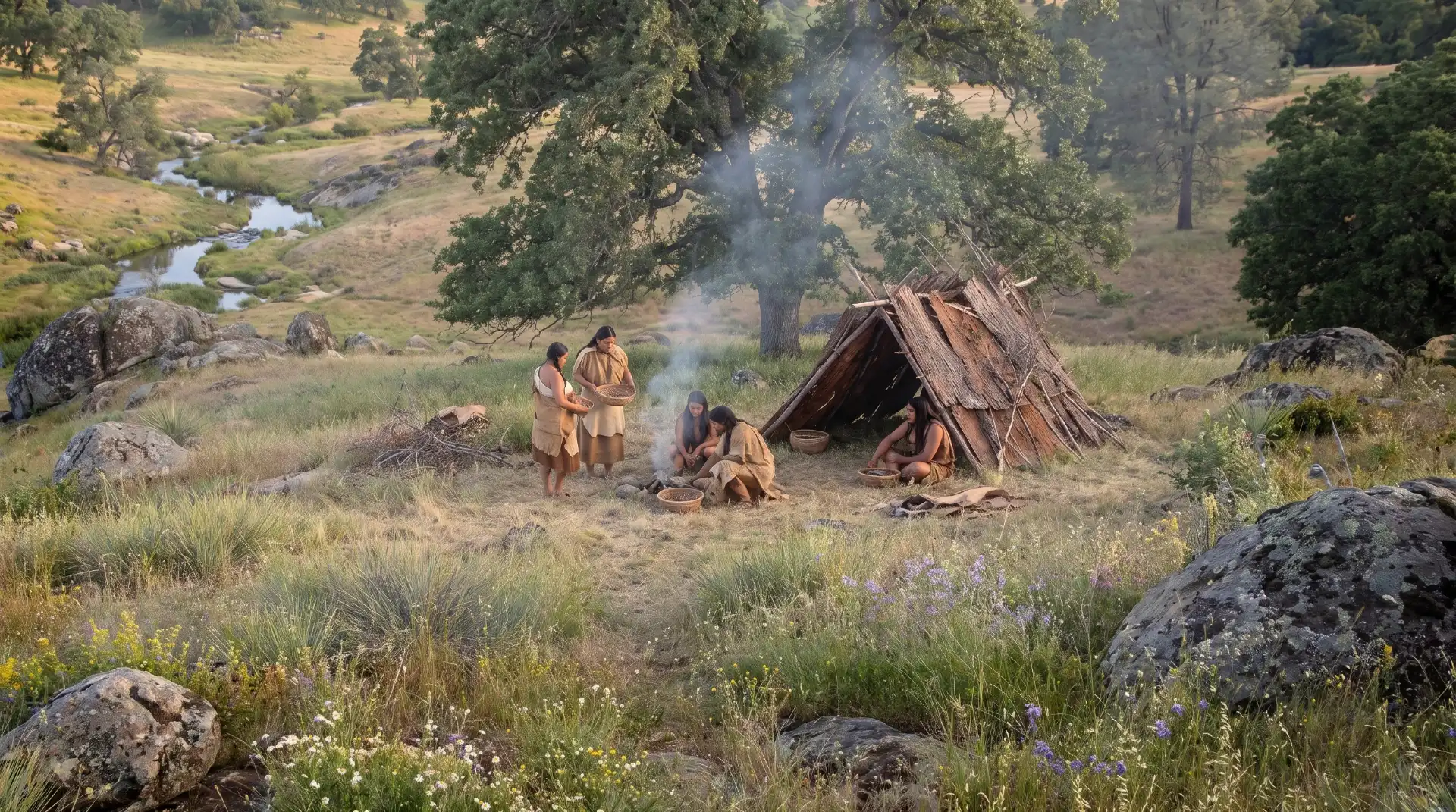
Native communities lived throughout the Sierra Nevada and San Joaquin Valley for thousands of years before American settlement transformed the region. The area surrounding present-day Madera County was home to Native peoples whose communities developed sophisticated relationships with the landscape.
The Southern Sierra Miwok were among the Native people associated with the region around Wassama. Chukchansi Yokuts people are also closely connected with the broader cultural history of the area and with the continuing use of the site.
Rather than thinking of pre-contact California as an untouched wilderness, it is more accurate to understand it as a landscape that Native communities knew intimately and actively managed. People gathered acorns, seeds, berries, roots, and medicinal plants. They hunted and fished, maintained travel routes, exchanged goods, produced baskets and tools, and passed detailed environmental knowledge from one generation to the next.
Oak trees were especially important throughout much of central California. Acorns could be processed into an important food source, while other native plants supplied materials for baskets, tools, medicines, shelters, and everyday life. Seasonal movement and community gatherings connected people across a much larger geographic region.
Social and ceremonial places were therefore part of a broader cultural landscape. A round house was not isolated from the surrounding land. It existed within a network of communities, resources, family relationships, traditions, and spiritual responsibilities.
A Round House Built for Community
A ceremonial round house can be understood as a community gathering place, but that description captures only part of its significance. Historically, round houses in central California could serve important social, spiritual, ceremonial, and communal purposes.
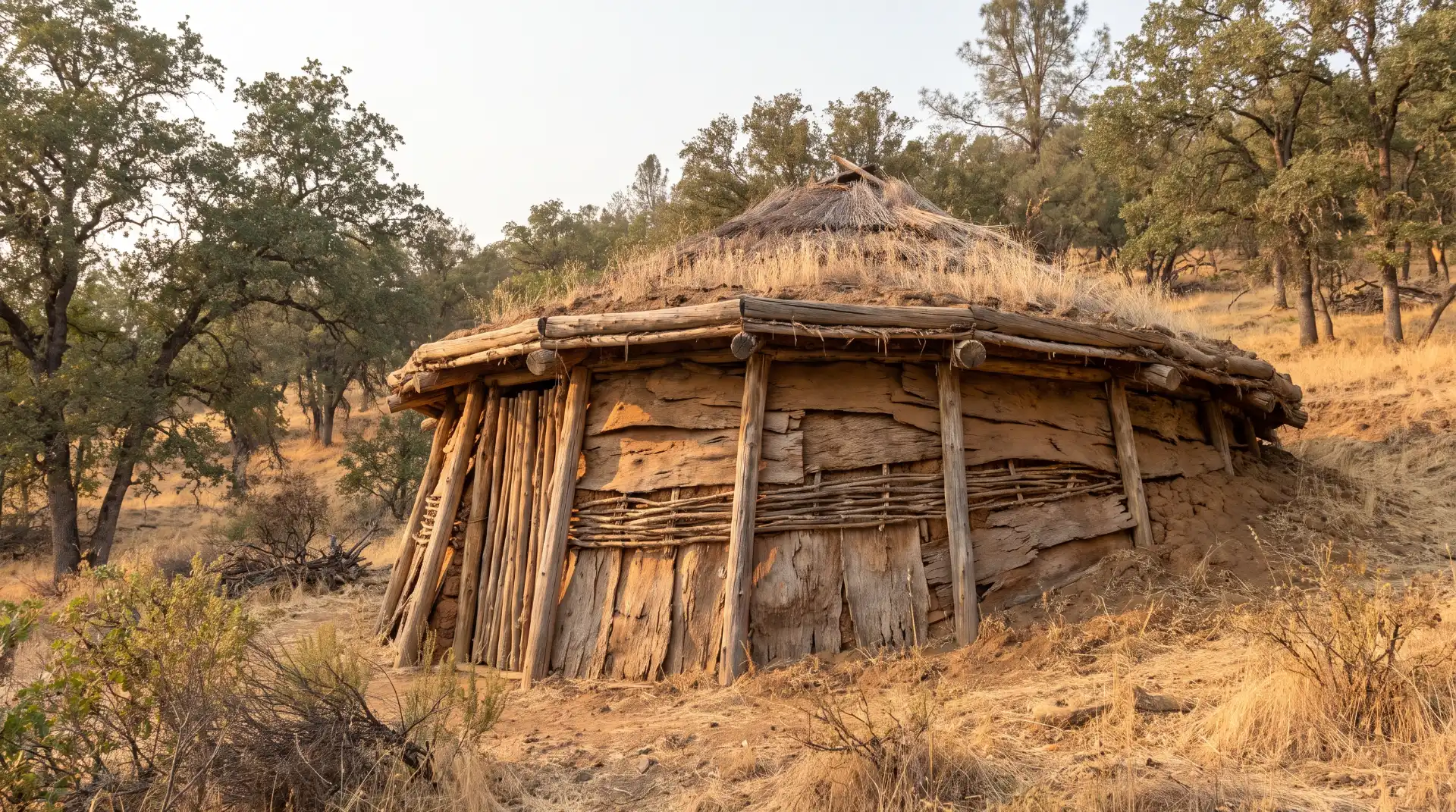
California State Parks records that an early round house at the Wassama location was documented by the U.S. Geological Survey in 1858. The structure was semi-subterranean and was used for traditional gatherings that included harvest and mourning dances as well as hand games.
The existence of that documented structure in the 1850s does not mean the cultural history of the location began then. Rather, the documentary record created by outsiders provides one historical reference point for a Native tradition that was already established.
Round houses were traditionally built largely from materials available in the surrounding environment. Their circular form created a shared interior space suited to community gatherings and ceremonial use. Architecture, however, cannot be separated from cultural practice. To Native communities, a round house could carry meanings that are not fully visible to an outside observer.
For that reason, modern visitors should approach Wassama differently from an abandoned mining cabin or reconstructed railroad depot. It is a historic structure, but it is also associated with living cultural traditions. Respect for that continuing use is an essential part of understanding the site.
The Gold Rush Changed the Sierra Foothills
The discovery of gold in California in 1848 brought enormous changes to Native communities throughout the Sierra Nevada. Thousands of newcomers entered traditional Native lands seeking mineral wealth and opportunities associated with the rapidly expanding American economy.
Mining was only one source of disruption. New settlements, ranches, roads, timber operations, and agricultural development transformed landscapes that Native people depended upon. Violence, introduced diseases, hunger, displacement, and discriminatory government policies caused catastrophic population losses among California Native communities.
The history associated with Wassama reflects this much larger California story.
In 1851, federal representatives negotiated a series of treaties with California tribes that were supposed to establish lands for Native communities. The treaty associated with Native people in the Southern Sierra region was never ratified by the United States Senate. For decades, the treaties themselves were effectively hidden from public view.
Without the promised protections, Native communities faced continuing pressure on their land and resources.
According to the official California State Parks history of Wassama, the Native population of Mariposa and Madera counties had fallen dramatically by the early twentieth century. The statistic represents more than demographic change. Behind the numbers were families, villages, languages, traditions, and communities struggling to survive one of the most disruptive periods in California history.
Yet survival is precisely what makes Wassama so important. The ceremonial place did not simply disappear.
Successive Generations of Round Houses
The structure visitors associate with Wassama today is part of a sequence of round houses constructed at the site.
State Parks documentation indicates that the first historically documented structure was followed by another round house built during the nineteenth century. Traditional practices surrounding the death of community leaders affected the fate of some earlier buildings, and a later round house was constructed in 1903.
The 1903 building was reportedly constructed with help from Jim Roane, Charlie Roane, Johnny Gibbs, and Peter Westfall. Significantly, portions of a center pole associated with earlier structures were incorporated into the building.
This physical reuse provides a striking illustration of continuity. A new building could replace an older one while maintaining a tangible connection to earlier generations.
The California Office of Historic Preservation notes that the 1903 round house used portions of the center pole from two previous houses. Wassama is now recognized as part of California Historical Landmark No. 1001, which addresses California Native American ceremonial roundhouses.
Chief Peter Westfall and the Wassama Land
The early twentieth-century history of Wassama is closely connected with Peter Westfall.
In 1912, Westfall applied to the federal government for an allotment covering approximately 78.6 acres that included the round house. The allotment was eventually granted in the early 1920s.
The significance of securing the land should be considered against the larger history of Native dispossession in California. By this point, Native communities had experienced decades of pressure on their traditional territories. Maintaining control over land containing a ceremonial gathering place offered an important measure of protection.
When Westfall died in 1924, the round house was not burned. State Parks records that this was done at his request. The structure therefore continued to serve as a gathering and ceremonial place.
That decision allowed the building to remain connected with Native community life for decades after his death.
A Difficult Period After 1952
Another major change occurred in 1952 when the property passed into non-Native ownership.
Although traditional dances continued for a period, access became increasingly difficult. California State Parks’ historical account notes that the private owners eventually restricted Miwok access to the round house.
This chapter illustrates why ownership can have such profound implications for cultural preservation. A building may remain physically standing while the people whose traditions give it meaning lose the ability to use it.
For Native ceremonial places, preservation therefore requires more than preventing demolition. Continued cultural access can be just as important as protecting wood, earth, stone, or other physical components.
The eventual preservation of Wassama would depend heavily on Native people organizing to protect that connection.
The Wassama Roundhouse Association
During the early 1970s, Native people from communities including Ahwahnee, Coarsegold, and Oakhurst organized the Wassama Roundhouse Association.
Their efforts focused on recovering and preserving the round house property. This local campaign became an important turning point in the site’s modern history.
Community advocates worked alongside other supporters to bring attention to Wassama’s cultural importance. Their work eventually contributed to legislation allowing California State Parks to acquire the property for preservation in 1978.
This history matters because it changes the usual preservation narrative. Wassama was not simply identified by government officials and then protected from above. Native community members were central to the effort to preserve a place that remained important to them.
The campaign also took place during a broader period when Americans were reconsidering historic preservation and Native American cultural rights. Across the United States, activists, tribal communities, historians, archaeologists, and preservation organizations increasingly challenged older approaches that treated Native places primarily as archaeological remains rather than parts of living cultures.
The Collapse and Reconstruction of the Round House
Shortly before California State Parks acquired the property, the existing round house collapsed.
The loss could have marked the end of the structure’s physical history, but Native volunteers and park staff worked to reconstruct it. The replacement was designed to duplicate its predecessor and was completed during the 1980s.
California State Parks identifies the present structure as a reconstruction dating to 1985, while some state publications reference its dedication during the following year. More important than the exact administrative date is the role the rebuilt structure assumed afterward: it once again became a place where traditional community activities could continue.
The reconstruction demonstrates an important distinction between historical authenticity and cultural continuity. A building does not necessarily lose all significance because some of its materials are newer. For a living cultural place, the continuation of community use, knowledge, tradition, and connection can carry meanings that extend beyond the age of individual timbers.
Why Wassama Is a Living Historic Place
Many historic parks invite visitors to imagine activities that disappeared generations ago. Wassama is fundamentally different.
The round house continues to be associated with Native ceremonial and community use. California State Parks specifically describes it as a traditional meeting place that is still used by Southern Sierra Miwok people.
The agency’s historical materials also identify continuing use by Southern Sierra Miwok and Chukchansi Yokuts people.
That continuity explains why the phrase living heritage is particularly appropriate here.
Living heritage recognizes that history can survive through practices, knowledge, relationships, language, ceremonies, craftsmanship, storytelling, and community memory. A cultural resource can simultaneously belong to history and contemporary life.
Visitors sometimes encounter Native American places through museum exhibits where baskets, tools, clothing, photographs, and other objects are placed behind glass. Such collections can provide valuable educational opportunities, but Wassama offers another perspective. It reminds visitors that Native American culture is not confined to museums or to the distant past.
Native communities remain part of contemporary Madera County and California.
Gathering Day and Cultural Continuity
One of the best-known public events associated with the park is Gathering Day. California State Parks states that the event is traditionally held on the third Saturday of October and can include Native dancing, crafts, and basket-weaving demonstrations.
Events like Gathering Day can help visitors learn about cultural traditions while also recognizing that these traditions belong to living communities rather than historical reenactors portraying a vanished population.
That distinction is critical.
Native history is sometimes presented in American education as though Indigenous people existed only before westward expansion. Places like Wassama challenge that framework. The same communities that endured dispossession and dramatic population decline also maintained traditions, organized preservation efforts, rebuilt cultural structures, taught younger generations, and continue to gather.
Visitors interested in attending public programs should always verify current schedules through California State Parks before traveling. Ceremonial activities are not automatically public events, and respectful visitation means recognizing that some cultural practices may not be intended for observation or photography.
Basketry, Knowledge, and the Natural Landscape
Basketry is among the Native Californian traditions frequently highlighted during public cultural demonstrations. California Indian basketry developed to an extraordinary level of technical and artistic sophistication, with baskets created for gathering, storage, food preparation, carrying, ceremonial purposes, and many other uses.
The craft depends on detailed ecological knowledge. Basket makers must understand which plants provide appropriate materials, when those materials should be gathered, how they should be prepared, and how landscapes can be cared for so that useful plants remain healthy.
This relationship illustrates why Native cultural heritage cannot be fully separated from environmental history.
The oak woodlands surrounding Wassama, for example, are more than scenery. They form part of a landscape that supported generations of Native life. Plants, wildlife, water, seasonal cycles, and geography influenced foodways, travel, social relationships, material culture, and ceremony.
Learning the history of Wassama therefore encourages a broader understanding of Madera County. The natural environment itself is part of the historical record.
Wassama and California Historical Landmark No. 1001
The State of California recognizes Wassama’s significance through the California Historical Landmark program.
The California Office of Historic Preservation lists Wassama as part of California Historical Landmark No. 1001, designated under the thematic recognition of California Native American ceremonial roundhouses.
The landmark description emphasizes that Wassama predates the 1860s, that successive structures occupied the location, and that the round house served as a center of spiritual and ceremonial life for Native Californians.
Perhaps the most important portion of the designation, however, is its recognition that the round house continues to serve a ceremonial purpose.
Historic designations often commemorate something that happened once: a battle, the signing of a document, the construction of an important building, or the residence of a notable person. Wassama represents continuity instead. Its significance comes from repeated use across generations.
A Different Way to Understand Madera County History
Madera County was formally created in 1893 from part of Fresno County, but the history of the land extends far beyond county boundaries and incorporation dates.
Much of the region’s familiar historical narrative focuses on nineteenth- and twentieth-century development: gold mining in the foothills, timber operations in the Sierra, granite quarrying around Raymond, agricultural expansion in the valley, railroad construction, and the development of roads leading toward Yosemite.
Those stories are important, but they represent only relatively recent chapters.
Wassama pushes the timeline backward and broadens the meaning of local history. It asks visitors to consider communities that lived in the region before American political boundaries existed and that continued to survive after those boundaries were created.
It also encourages historians to think beyond written government documents. Native history can be preserved through oral tradition, landscapes, community knowledge, cultural practice, language, architecture, family history, and continued use of traditional places.
Preservation Means More Than Saving an Old Building
Wassama demonstrates how preservation can evolve.
For many years, American historic preservation concentrated heavily on architecture associated with government leaders, wealthy families, military events, or Euro-American settlement. Native places were frequently categorized as archaeological sites rather than living cultural landscapes.
Today, preservation professionals increasingly recognize the importance of working with Native communities to understand the cultural values attached to historic places.
At Wassama, the physical round house matters enormously, but so does the ability of Native people to continue gathering there.
The history of the Wassama Roundhouse Association reinforces that principle. The preservation movement was driven in significant part by people whose families and communities had direct cultural connections to the site.
The resulting state historic park therefore preserves both a location and an ongoing relationship.
Visiting Wassama Round House Today
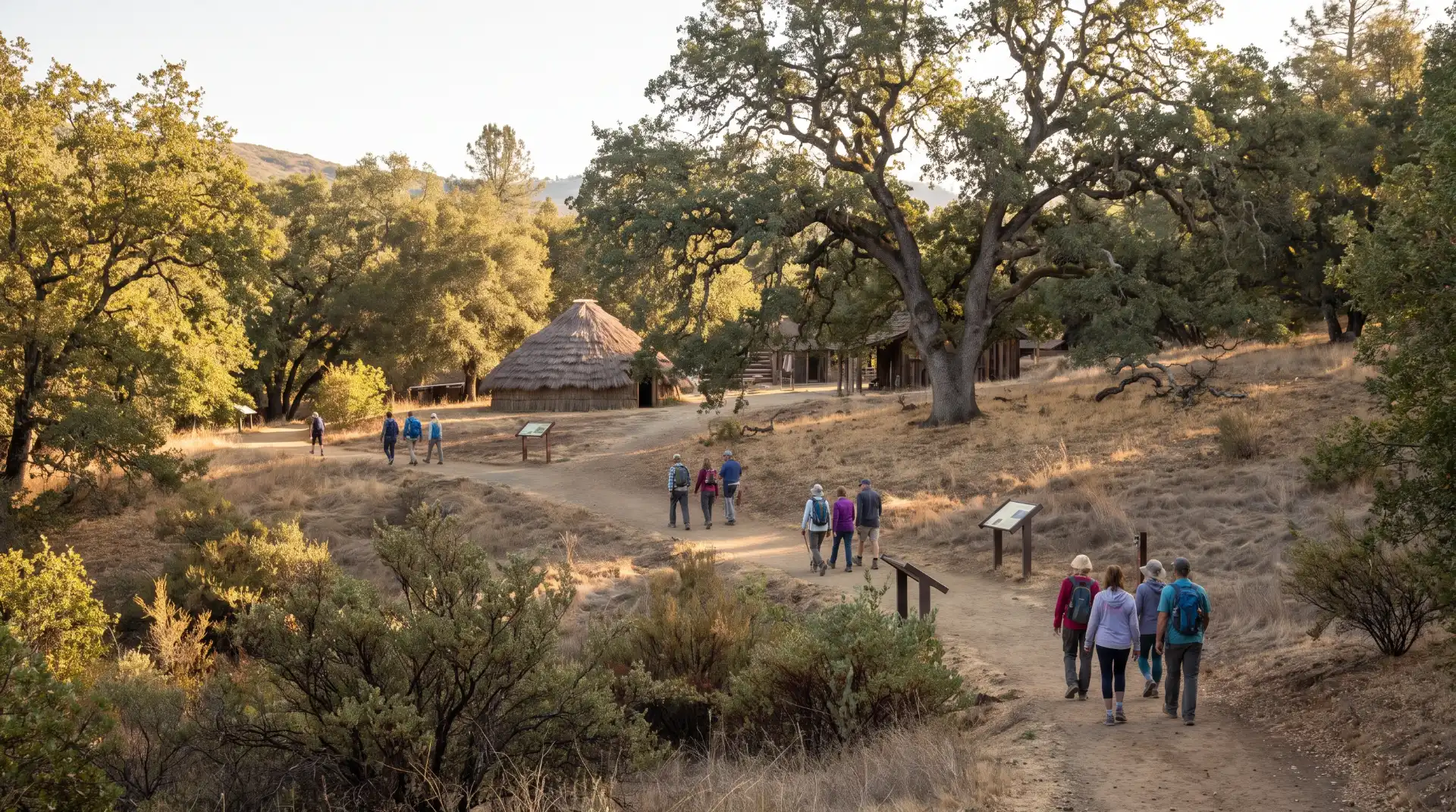
Wassama Round House State Historic Park is located on Road 628 near Ahwahnee, northwest of Oakhurst. California State Parks lists the property as a historical and cultural site with picnic areas and interpretive features.
Because the round house remains a culturally significant Native gathering place, visitors should approach the site respectfully. It should not be treated as a stage set, abandoned structure, or unrestricted photography location.
Visitors should remain in appropriate public areas, follow posted instructions, avoid disturbing plants or cultural resources, and respect any restrictions associated with ceremonies or community gatherings.
Operating conditions can change, and California State Parks currently advises visitors to contact the park regarding hours. Anyone planning a trip should check the official Wassama Round House State Historic Park visitor information page before leaving home.
This is especially important for travelers hoping to attend Gathering Day or another scheduled public program.
Why Wassama Matters to Madera County
Wassama Round House is important for reasons that reach well beyond the survival of a single structure.
It represents the deep Native history of the Sierra foothills. It documents the enormous disruption experienced by California Native communities during the nineteenth century. It tells a twentieth-century story of cultural persistence and community-led preservation. Most importantly, it remains connected to Native people today.
That combination makes Wassama one of Madera County’s most meaningful historic places.
A visitor can learn dates, names, and architectural details, but the larger lesson is about continuity. Generations changed. Political boundaries changed. Ownership changed. Buildings were constructed, lost, and rebuilt. Yet the relationship between Native communities and this gathering place survived.
This is why describing Wassama exclusively as an artifact of the past would miss its most important quality.
Keeping the Story Alive
Local history is strongest when it includes the people whose experiences are often missing from older historical narratives. Wassama Round House provides an opportunity to understand Madera County from a deeper perspective, beginning centuries before the county appeared on a California map.
The story includes ancient relationships with the Sierra landscape, ceremonial traditions, survival during a period of devastating displacement, the efforts of people such as Peter Westfall, the activism of the Wassama Roundhouse Association, and the work of Native volunteers who helped reconstruct the structure.
But the story does not stop with reconstruction.
The round house continues to have cultural meaning. Native traditions continue. Families continue to gather, teach, remember, and maintain connections with the land.
For historians and visitors alike, that makes Wassama more than a destination. It is evidence that heritage can remain alive even after extraordinary disruption.
Among Madera County’s historic courthouses, logging routes, mining communities, ranches, railroads, and pioneer buildings, Wassama Round House occupies a distinctive place. It connects the county’s present with a Native history far older than any surviving Euro-American structure in the region.
Preserving Wassama therefore preserves more than Madera County history. It helps protect an ongoing chapter of California Native American heritage — one that is still being lived today.
Learn More
For official park information, current access details, directions, and public-event information, visit California State Parks: Wassama Round House State Historic Park.
Additional historical designation information is available from the California Office of Historic Preservation’s Madera County landmark records.