
Madera County’s fruit and nut industry is one of the most recognizable parts of the Central Valley landscape. Across the agricultural areas surrounding Madera, Chowchilla, and other communities, rows of almond trees, pistachio orchards, vineyards, and other permanent crops demonstrate how dramatically the region’s agricultural economy has developed over generations. To someone passing through the county today, these orchards may appear to be a natural and permanent part of the landscape. Their presence, however, represents more than a century of agricultural experimentation, irrigation development, transportation improvements, changing markets, family farming, technological innovation, and the work of thousands of people who helped establish the Central Valley as one of the most productive agricultural regions in the United States.
The modern Madera County orchard is the result of a gradual transition from earlier forms of farming and other regional industries. Timber, ranching, grain production, mining, and transportation all played important roles in the county’s early development before permanent fruit and nut crops became such a dominant feature of the agricultural landscape. As irrigation systems expanded and transportation networks improved, farmers gained greater opportunities to invest in crops that required long-term planning. Almonds, pistachios, grapes, and other permanent crops eventually became important parts of the county’s agricultural economy. Today, UC Cooperative Extension identifies almonds, pistachios, milk, grapes, and several other commodities among Madera County’s leading agricultural products. (UC Cooperative Extension – Madera County Agriculture)
Understanding how this industry developed provides a deeper understanding of Madera County itself. The history of the orchard is also the history of water, railroads, roads, farm families, agricultural workers, businesses, technology, and community development. Every row of trees reflects decisions made by earlier generations, while the modern equipment and agricultural practices used in those same orchards demonstrate how California farming continues to evolve.
The Agricultural Landscape Before Modern Orchards
The agricultural history of Madera County began long before modern almond and pistachio orchards appeared across the Central Valley. Indigenous communities had lived throughout the region for generations before American settlement, developing detailed knowledge of the area’s rivers, foothills, plants, wildlife, and seasonal conditions. Later settlement brought significant changes to the land, as new communities developed around ranching, mining, timber production, transportation, and agriculture. These industries gradually established the economic foundation from which modern Madera County developed.
Madera County was officially established in 1893, but the community that became Madera had already begun developing during the nineteenth century. The city’s early history was strongly connected to the lumber industry, particularly the California Lumber Company and the large flume system that moved timber from the mountains toward the emerging community. The name Madera itself comes from the Spanish word for wood or lumber, reflecting the importance of timber to the region’s early economic identity. As transportation infrastructure expanded and the population increased, agriculture became increasingly important to the economy of the valley floor.
Early agriculture looked very different from today’s orchard landscape. Farmers grew crops such as wheat, barley, alfalfa, and other field crops, while ranching was also important throughout the region. These operations were strongly influenced by the availability of water and transportation. The eventual expansion of permanent crops required farmers to have greater confidence that water could be delivered consistently and that agricultural products could reach profitable markets. This is why the history of Madera County orchards cannot be separated from the development of irrigation and transportation.
From Lumber and Ranching to a Strong Agricultural Economy
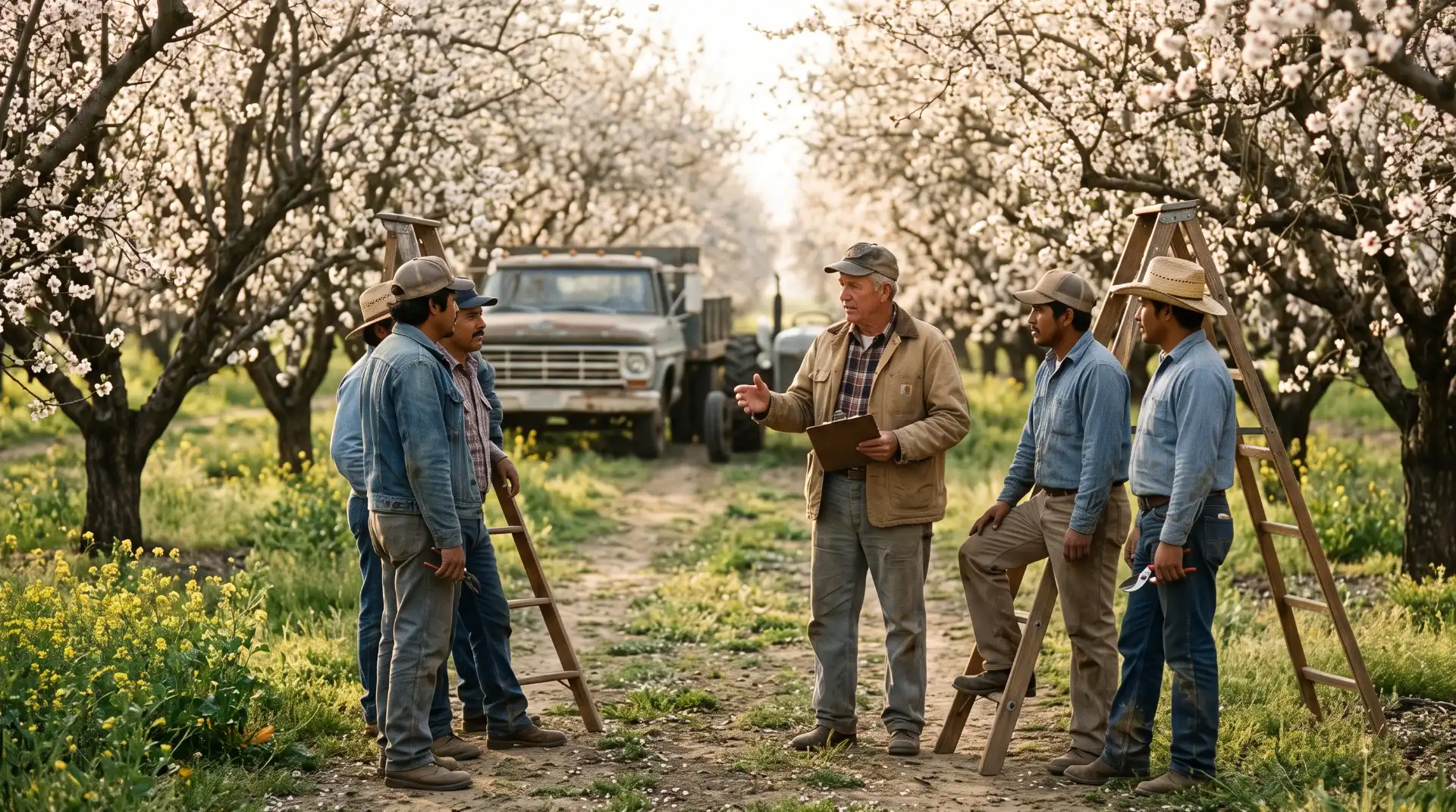
Madera County’s transition from an economy heavily influenced by timber and ranching toward a diversified agricultural economy happened over many decades. The early lumber industry contributed to population growth, transportation improvements, commercial businesses, and the development of Madera as a regional center. As the county’s population increased, farmers and businesses increasingly benefited from improved roads, rail connections, financial services, agricultural suppliers, and access to larger markets.
Agriculture eventually became one of the county’s most important economic foundations. The transformation was not simply a matter of farmers deciding to plant more crops. It involved the creation of an agricultural system capable of supporting commercial production on a large scale. Farmers needed irrigation water, machinery, labor, storage, transportation, processing, financing, and buyers. Businesses developed around those needs, creating a network that connected farms with communities throughout the region.
The broader agricultural history of the county is explored in the existing Madera History article Madera County’s Agricultural History: How Farming Built the Community. That history provides useful context for understanding how irrigation, transportation, farming, and local economic development became interconnected.
The fruit and nut industry grew within this larger agricultural transformation. Once infrastructure made permanent agriculture increasingly practical, farmers could make longer-term investments in orchards and vineyards. Instead of relying only on annual crops, they could establish plantings that would remain productive for many years, creating a very different relationship between agricultural land and the families who owned or worked it.
Water Made Permanent Orchards Possible
Water has always been one of the most important factors in Central Valley agriculture. Madera County experiences hot, dry summers, and the amount of natural summer rainfall is insufficient to support commercial orchards without irrigation. Almonds, pistachios, grapes, and other permanent crops require dependable water throughout their growing cycles, making irrigation infrastructure a fundamental part of the region’s agricultural history.
Early farmers developed systems to capture and move water from rivers and streams toward agricultural land. The Fresno River became particularly important to Madera’s development, while later irrigation projects expanded the amount of land that could support intensive agriculture. Historical accounts describe the development of the Madera Canal and Irrigation Company and other early water systems as important steps in the transformation of the surrounding agricultural landscape. (California Genealogy and History Archives)
The establishment of the Madera Irrigation District represented another major development. The district was created in the early twentieth century as local farmers and landowners sought a more dependable agricultural water supply. Over time, its irrigation network expanded to include extensive canals and pipelines serving agricultural land throughout the district.
Reliable irrigation changed the decisions farmers could make about their land. A grower considering an orchard needed to think years into the future because trees require significant time and investment before reaching full production. Without dependable water, that investment would carry enormous risk. With irrigation infrastructure in place, however, permanent crops became increasingly attractive to farmers looking for long-term agricultural opportunities.
Railroads Connected Madera County Farms With Larger Markets
Water made it possible to produce larger quantities of agricultural commodities, but transportation determined how efficiently those products could reach consumers. The development of railroads during the nineteenth century therefore had a profound effect on Madera County’s agricultural economy. Before modern highways and trucking networks, rail transportation provided one of the most efficient ways to move agricultural products over long distances.
The arrival of the railroad connected Madera with larger commercial centers and provided farmers with access to markets beyond the immediate region. Agricultural products could be shipped to other California communities and eventually to customers throughout the United States. The railroad also encouraged the development of warehouses, packing operations, agricultural supply businesses, financial institutions, and other services that supported commercial farming.
This connection between agriculture and transportation helped create a reinforcing cycle of economic growth. Farmers produced crops because they could reach markets, while businesses invested in agricultural services because there was a growing farming economy to support. As the agricultural industry expanded, roads and transportation systems improved, making it easier for even more farms to participate in regional and national markets.
The development of transportation also connected Madera County’s agricultural history with its earlier timber history. The same region that had once relied heavily on moving lumber from the mountains increasingly became a place where agricultural products were transported outward from the valley. The economic direction of the county changed, but transportation remained at the center of that development.
Grapes Helped Establish the Tradition of Permanent Crops
Before almonds and pistachios became dominant parts of modern Madera County agriculture, grapes were already an important component of the region’s agricultural economy. Madera County historically produced raisin grapes, table grapes, and wine grapes, creating agricultural operations that required specialized knowledge of irrigation, pruning, pest management, harvesting, and marketing.
Grapes were important not only because of their economic value but also because they reinforced the development of permanent agricultural production. Vineyards require a long-term investment, and successful growers must manage their land differently from farmers who plant annual crops. The growth of vineyards helped establish a culture of agricultural planning that extended beyond a single growing season.
Historical crop reports demonstrate that grapes remained an important commodity through multiple decades, even as other crops increased in importance. This changing agricultural mix is one of the most interesting characteristics of Madera County history. Farmers did not simply abandon older crops whenever a new crop became popular. Instead, different agricultural industries developed alongside one another, and individual farms often changed their production strategies in response to market conditions.
The history of grapes also illustrates why the county’s fruit and nut industry should not be viewed as a story about only almonds and pistachios. Madera County’s agricultural tradition has always involved experimentation and diversification, with farmers evaluating which crops could provide sustainable returns under changing economic and environmental conditions.
Almonds Became a Defining Part of Madera County Agriculture
The expansion of almond production represents one of the most important changes in Madera County’s modern agricultural landscape. Almonds were present in California agriculture long before they became dominant in Madera County, but production expanded substantially during the second half of the twentieth century. Historical agricultural information shows that almonds moved from a relatively modest position among the county’s leading commodities into one of its most valuable crops.
The broader Madera County agricultural history documents this dramatic change, noting that almonds ranked sixth among leading commodities in 1977 but had risen to second place by 1987.
That growth changed the appearance of the valley floor. As more acreage was planted with almond trees, orchards became an increasingly recognizable part of the Madera County landscape. The trees also created a distinctive seasonal cycle, with winter dormancy followed by the famous bloom period and then months of irrigation, orchard management, crop development, and harvest preparation.
Almond production requires considerable long-term planning. Trees must be established and maintained before they become fully productive, and growers must manage irrigation, nutrition, pests, diseases, pollination, pruning, and harvesting. The decision to establish an almond orchard therefore represents a significant investment in the future of a property.
For families who remain involved in agriculture for generations, those decisions can have lasting consequences. An orchard planted by one generation may continue producing for another, turning agricultural land into a living record of family history.
Almond Bloom Became Part of the Central Valley Landscape
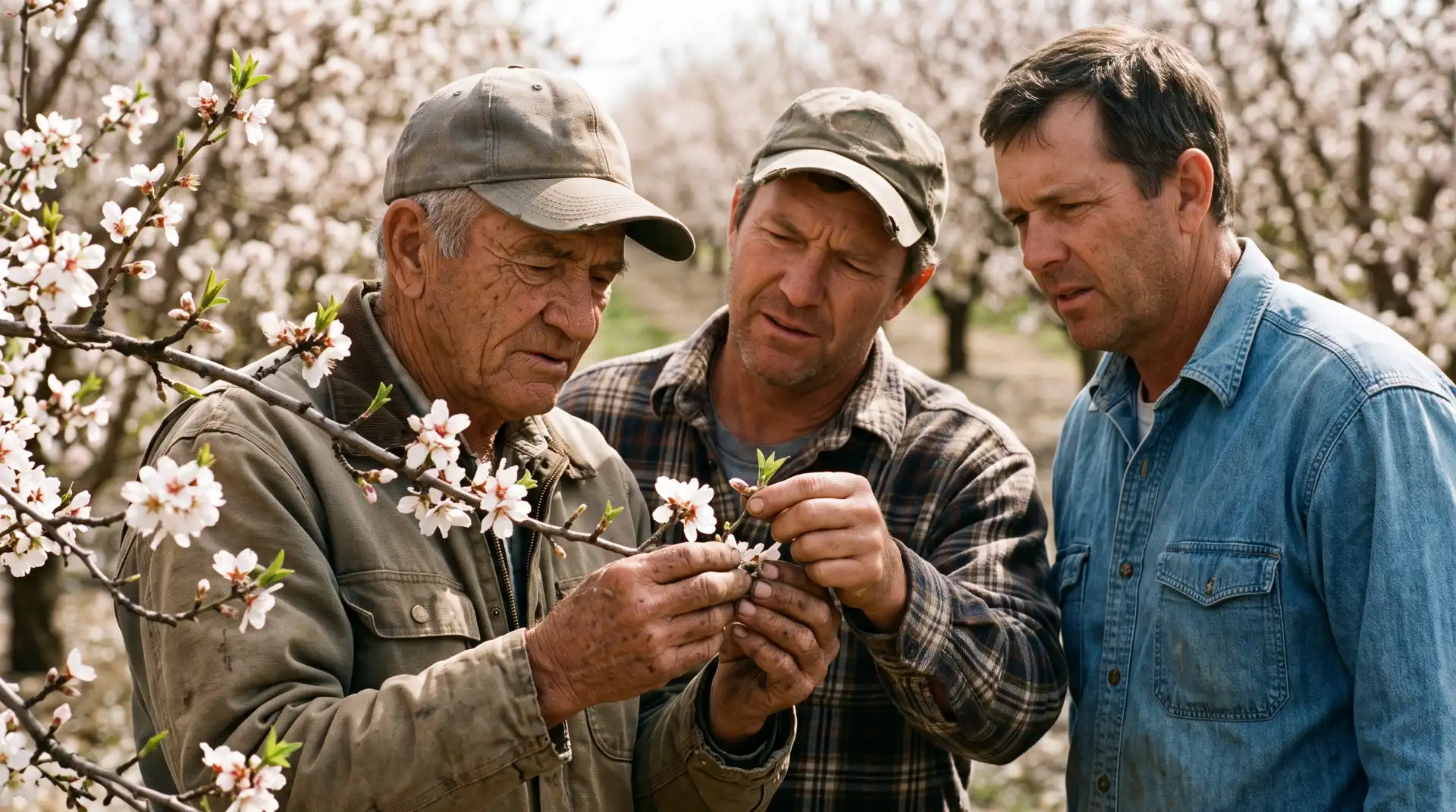
Few agricultural scenes are as recognizable as an almond orchard during bloom. For a short period each year, thousands of trees can produce a dramatic display of white and pale pink flowers. In a region better known for summer heat and dry landscapes, the bloom period provides a reminder of the seasonal cycles that define Central Valley agriculture.
The beauty of almond bloom can sometimes hide the complexity of what is happening in the orchard. Pollination is essential, and growers must carefully manage orchard conditions during a relatively short flowering period. Weather can influence bloom timing and pollination success, while bees play a crucial role in transferring pollen between flowers.
Madera County’s agricultural economy includes pollination services as an important component of the broader agricultural system. UC Cooperative Extension identifies pollination among the county’s major agricultural commodities and services, demonstrating how the orchard industry depends on businesses and agricultural activities that may not be immediately visible to the public. The almond orchard is therefore an excellent example of agricultural interdependence. Trees, bees, beekeepers, irrigation systems, farm workers, machinery, transportation, processors, and markets all contribute to the eventual crop.
Pistachios Changed the Agricultural Equation
Pistachios provide another important example of how quickly an agricultural commodity can grow in importance. During the 1970s, pistachio production represented only a small portion of Madera County’s agricultural acreage. Over the following decades, however, pistachio acreage increased substantially and the crop became one of the county’s leading agricultural commodities.
The growth of pistachios demonstrates the ability of Central Valley farmers to respond to changing markets. Agricultural decisions are influenced by crop prices, water requirements, production costs, consumer demand, processing infrastructure, and expectations about future profitability. Farmers considering permanent crops must evaluate those factors years before an orchard reaches full production.
Modern Madera County agriculture reflects the success of that long-term decision-making. UC Cooperative Extension currently lists pistachios among the county’s highest-value commodities, alongside almonds, grapes, milk, and other major products.
Pistachio orchards also demonstrate how agricultural landscapes can change within a single generation. A crop that was relatively uncommon in an earlier agricultural report can become a major part of the local landscape decades later. This is an important reminder that the Central Valley has never been an agricultural environment frozen in time.
The People Behind the Orchards
Crop statistics tell only part of the agricultural story. Behind every acre of almonds, pistachios, grapes, or other permanent crops are people who plant, maintain, irrigate, harvest, transport, process, and market those commodities. Farmers and farm families make long-term decisions about land and crops, while agricultural workers perform many of the daily tasks required to keep orchards productive.
The work changes throughout the year. Winter and early spring may involve pruning, irrigation preparation, orchard maintenance, and other activities, while bloom creates a particularly important period for almond growers. As crops develop, workers monitor trees, manage water and nutrients, address pest concerns, and prepare equipment for harvest. Harvest itself creates a period of intense activity involving machinery, transportation, processing, and storage.
The agricultural workforce therefore contributes to the rhythm of Madera County communities. Seasonal work affects transportation, housing, local businesses, schools, restaurants, and other services. Agriculture creates demand well beyond the boundaries of the farm.
For that reason, the history of Madera County’s orchards is also the history of its agricultural workers and the families who built their lives around farming.
Family Farming and Agricultural Knowledge
Generational knowledge is another important part of Madera County’s agricultural tradition. Farming is not simply a matter of following instructions from a manual. Experienced growers develop an understanding of their land that can take decades to acquire. They learn how particular soils respond to irrigation, how trees react to weather, where drainage problems occur, and when certain agricultural tasks should be completed.
Much of that knowledge is passed informally between generations. Children may grow up watching parents and grandparents work in the orchard, gradually learning how the farm operates. Older generations can teach younger family members about equipment, irrigation, pruning, harvest preparation, and the history of the property.
This knowledge becomes especially valuable when agricultural conditions change. A family that understands how its land has responded to previous droughts, floods, market changes, or crop transitions can draw upon that experience when making new decisions.
The result is an agricultural tradition that combines historical knowledge with modern science. Farmers today have access to sophisticated technology and research, but many continue to rely on practical experience developed over generations.
The Orchard Economy Supports More Than Farmers
One of the most important characteristics of Madera County’s fruit and nut industry is the extensive economic network that surrounds each orchard. Farmers need irrigation equipment, tractors, harvesting machinery, fertilizers, agricultural supplies, fuel, financial services, insurance, crop consultants, mechanics, transportation, storage, processing, and marketing.
This creates employment and business opportunities throughout the county.
An agricultural equipment dealer may depend on orchard growers for customers. A mechanic may specialize in maintaining farm machinery. A trucking company may transport agricultural commodities. A warehouse may store harvested products. Processing facilities may clean, sort, package, or prepare nuts for distribution.
These connections explain why agriculture has historically had such a large influence on Madera County’s overall economy. The economic value of an orchard cannot be measured only by the value of the crop harvested from the trees. The industry supports an extensive network of businesses and workers.
From Harvest to National and International Markets
Once fruit and nuts leave the orchard, their journey continues through processing and distribution networks. Almonds and pistachios may be cleaned, sorted, processed, packaged, stored, and transported to buyers across the country or overseas. Grapes may enter different markets depending on variety and intended use.
This means a Madera County orchard can be connected to consumers thousands of miles away.
The local nature of farming and the global nature of agricultural markets exist side by side. The trees are rooted in Madera County, but the economic network surrounding their products can extend across the United States and around the world.
This connection is particularly important when considering the county’s place within California agriculture. Madera County is not an isolated farming region. It participates in a statewide agricultural economy that has become one of the most important food-producing systems in the United States.
Technology Has Changed the Modern Orchard
The modern orchard may look similar to an orchard of several decades ago, but the technology used to manage it has changed considerably. Farmers can now use GPS-guided machinery, weather monitoring, soil-moisture information, automated irrigation systems, improved harvesting equipment, and other technologies to manage agricultural operations more precisely.
These tools can help growers make better decisions about water, crop health, timing, and equipment use. Agricultural research also provides information about varieties, pests, diseases, soil management, and other issues affecting production.
UC Cooperative Extension continues to support Madera County agriculture through programs related to fruit and nut production, viticulture, irrigation, pest management, and other agricultural subjects. Technology does not eliminate the need for agricultural experience. Instead, it gives farmers additional information that can be combined with knowledge gained through years of working the land.
Water Challenges and the Future of Orchards
Water will remain one of the most important issues affecting Madera County’s agricultural future. Permanent crops require long-term irrigation planning, and farmers must consider drought, groundwater conditions, surface-water availability, irrigation efficiency, and changing environmental conditions when making decisions about orchards.
Modern irrigation systems can help growers use water more efficiently, while soil monitoring and other technologies can provide information about crop water needs. Nevertheless, the fundamental importance of water has not changed since the earliest days of commercial agriculture.
The Madera Irrigation District’s extensive irrigation infrastructure demonstrates how central water has been to the county’s agricultural development. Its history is closely connected to the transformation of the region from a landscape dominated by less intensive agriculture into one capable of supporting large areas of permanent crops. (Madera Irrigation District)
Future generations will face different water challenges from those faced by the first orchard growers, but the basic question will remain familiar: how can the region maintain productive agriculture while managing a limited and highly valuable resource?
Agriculture and the History of Madera Communities
The growth of agriculture influenced much more than farm properties. It shaped the communities around them.
As agricultural production expanded, Madera County needed businesses and services capable of supporting a growing population. Stores, schools, banks, restaurants, equipment dealers, repair shops, transportation companies, and other businesses developed in response to the agricultural economy.
The relationship between agriculture and community development is particularly important when studying Madera’s history because farming provided an economic foundation that lasted beyond individual crop cycles.
Agriculture also connected different parts of the county. Valley communities were linked to mountain communities through roads and commercial networks, while agricultural products and timber moved through the same broader transportation system.
Madera County’s earlier mining communities provide another example of this interconnected history. Historic settlements developed around gold mining and other industries before many of their original economic functions disappeared or changed. The story of these communities can be explored in The Forgotten Gold Rush Towns and Mining Settlements of Madera County, which examines the people, industries, transportation routes, and communities that shaped the county’s earlier history.
This broader context is important because the agricultural economy did not develop independently. It emerged from the same networks of transportation, natural resources, settlement, and economic change that shaped the rest of Madera County.
Agricultural Landscapes Are Historical Resources
A historic building is often easy to recognize as a piece of the past, but agricultural landscapes can be more difficult to identify as historical resources. An orchard may look like an ordinary working farm, even though the trees, irrigation structures, barns, roads, and equipment may represent decades of local history.
An old orchard can reveal when a particular crop became important in a region. A historic irrigation canal can demonstrate how farmers gained access to water. An agricultural building can show how crops were stored or processed. Old farm equipment can reveal technological changes.
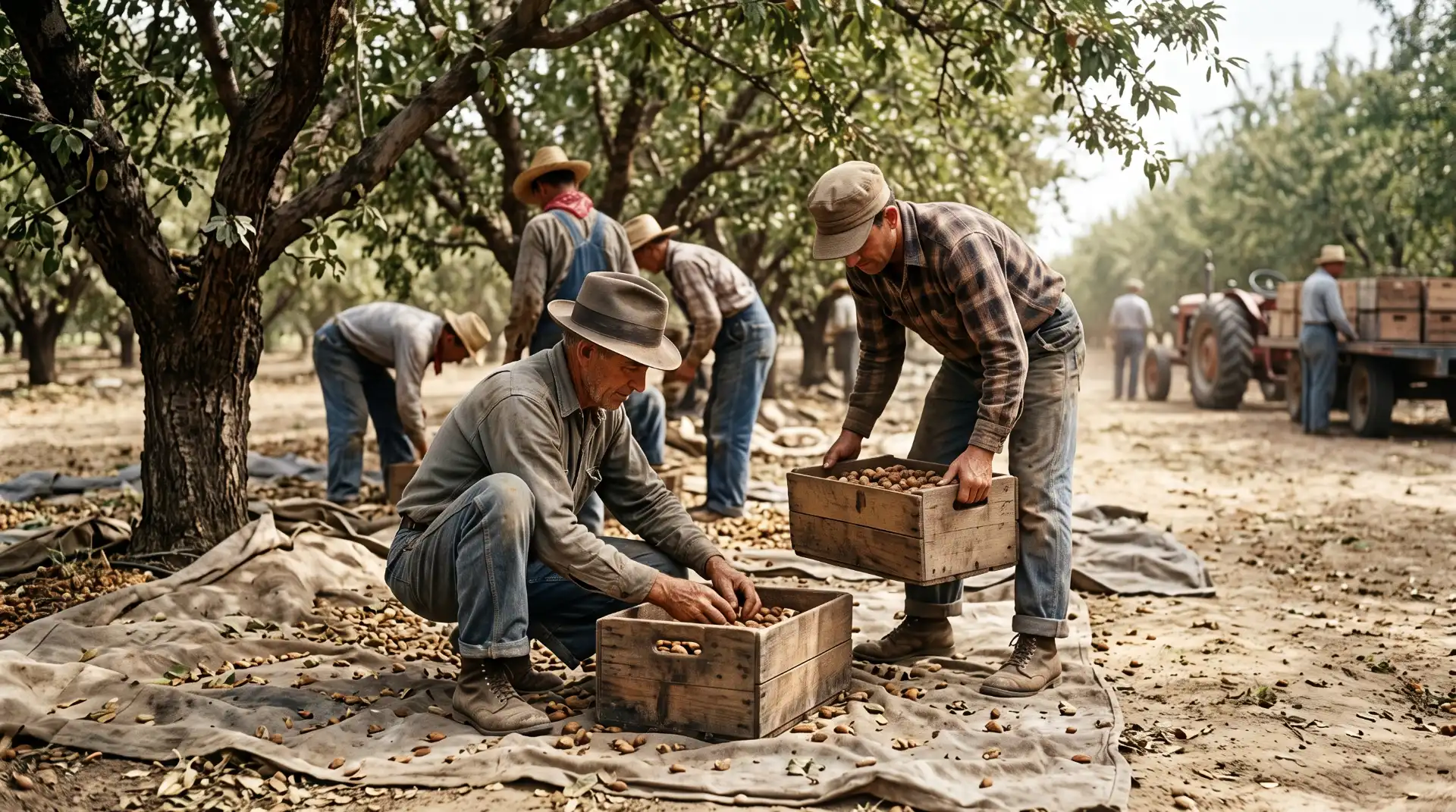
Photographs are equally valuable. Images of families standing beside orchards, workers harvesting grapes, agricultural machinery operating in fields, or farm buildings surrounded by trees can document aspects of Madera County history that written records may not capture.
Preserving these materials helps future generations understand that agriculture was not simply an economic activity. It was a way of life that shaped the county’s communities and identity.
Historical Crop Reports Help Tell the Story
Historical agricultural reports are especially valuable because they allow researchers to measure change. A photograph may show what an orchard looked like, but a crop report can reveal how many acres were devoted to a particular commodity and how its economic value changed over time.
Comparing historical records helps explain the rise of almonds and pistachios.
It also shows that other crops once played much larger roles in the county’s economy. Grapes, cotton, alfalfa, dairy, cattle, and other agricultural products have all contributed to Madera County’s changing agricultural landscape.
These changes were influenced by many factors, including market prices, water availability, consumer demand, production costs, technology, and environmental conditions.
The numbers therefore tell a larger story about agricultural decision-making.
When almond acreage expanded, farmers were responding to economic opportunities and agricultural conditions. When pistachios became more important, growers were again adapting to changing circumstances.
Agriculture is therefore a history of decisions as much as it is a history of crops.
Preserving the Memory of Madera County Farms
The agricultural landscape will continue to change, which makes historical preservation especially important. Orchards may eventually be removed, properties may change ownership, farm buildings may disappear, and equipment may be replaced.
Without deliberate preservation, valuable stories can be lost.
Families can help preserve agricultural history by keeping photographs, letters, property documents, farm records, newspaper clippings, equipment manuals, maps, and oral histories. Local historical organizations can help place those materials within the broader story of the county.
The goal is not necessarily to preserve every farm exactly as it looks today.
Instead, the goal is to preserve enough evidence to help future generations understand how agriculture changed and why those changes mattered.
The Future of Madera County’s Fruit and Nut Industry
The future will undoubtedly bring additional changes to Madera County agriculture. Farmers will continue to respond to water conditions, climate patterns, commodity markets, technological developments, labor considerations, consumer demand, and agricultural research.
Some orchards may remain in production for generations, while others may be replanted with different varieties or crops. New technologies may improve irrigation efficiency and crop monitoring. Agricultural research may provide new approaches to pest management, soil health, water use, and crop production.
These changes should not be viewed as a departure from Madera County’s agricultural tradition.
Adaptation has always been part of that tradition.
The farmers who established early vineyards adapted to the markets and technology available to them. Later generations expanded almond production as the economics of the crop changed. Pistachio growers responded to new opportunities and established another important part of the county’s agricultural economy.
Future farmers will make similar decisions under different circumstances.
Why the Orchard Tradition Still Matters
The importance of Madera County’s orchards extends beyond the economic value of their annual harvest. They represent the cumulative effect of generations of agricultural decisions and labor.
A mature orchard may reflect decades of irrigation investment, family knowledge, agricultural research, and changing market conditions. The roads surrounding it may have been developed partly because of agricultural transportation needs. Local businesses may exist because farmers needed equipment and services. Families may have remained in the community because agriculture provided employment and economic opportunity.
This makes agriculture one of the central threads connecting Madera County’s past and present.
The county’s history is not contained only in historic buildings, museums, or old photographs.
It can also be found in the fields.
Final Thoughts: Orchards as Living History
Madera County’s fruit and nut industry developed through a long process of agricultural experimentation, infrastructure development, economic change, and generational adaptation. The orchards that cover portions of the Central Valley today were made possible by the development of irrigation, transportation, markets, agricultural research, farm equipment, labor networks, and family farming traditions.
Almonds became one of the county’s defining crops after expanding dramatically during the twentieth century. Pistachios later developed from a relatively small agricultural commodity into another major part of the local economy. Grapes maintained an important role throughout much of this transformation, while dairy, cattle, alfalfa, nursery products, and other commodities continued to diversify the county’s agricultural economy.
The story is important because it demonstrates that landscapes are rarely permanent. What appears natural today may actually represent generations of decisions and investments. The rows of trees that seem to have always belonged to Madera County are relatively recent expressions of a much longer agricultural history.
The people who planted those trees, maintained the irrigation systems, harvested the crops, transported the products, operated processing facilities, managed agricultural businesses, and passed farming knowledge to their children all contributed to the county’s development.
That is why Madera County’s orchards should be understood as more than productive agricultural land. They are living historical landscapes that connect the county’s past with its present and future.
The next time an almond orchard blooms across the Central Valley or a line of pistachio trees stretches along a rural Madera County road, the scene can be viewed as more than beautiful agricultural scenery. Behind those trees is a history of water, transportation, family farming, labor, technology, commerce, and community development.
The orchard is part of the story of how Madera County became the community it is today, and its continuing evolution will become another chapter in the county’s history for future generations to remember.